
Sam
Sam sweet cherry originates from Canada, where it was developed at the renowned Summerland Research Station in British Columbia through planned crossing of Windsor and an open-pollinated selection. It was officially released into production in 1953. Due to its beautiful, intense dark color, pronounced fruit flesh firmness, high productivity, and unique, unsurpassed resistance to cracking, it is a highly valued and reliable commercial sweet cherry variety. It is considered absolutely the best choice for climates and regions with unstable, rainy, and humid summers.
It is a fully cross-pollinated variety. Since it flowers medium-late, its best, biologically synchronized, and field-proven pollinators are Van, Bing, Lambert, and the self-fertile Stella. Very early varieties, such as Burlat, cannot successfully serve as pollinators due to poor overlap in the flowering stages. The variety itself has exceptionally high-quality pollen and is an excellent pollinator for all other late-flowering varieties that are not in its sterility group.
The tree is very vigorous, strong, robust, and long-lived, with distinctly upright branch growth forming an attractive, tall, stable, and pyramidal canopy. It enters full bearing early when grafted onto modern low-vigor rootstocks, as early as the second or third year after planting. Once it starts bearing, with the presence of suitable late-flowering pollinators, it produces regular, stable, very high, and abundant yields every year. Mandatory bending and training of young shoots in the first two years are required in order to widen the canopy branch angles, control its naturally strong upright growth, and accelerate the formation of fruiting elements.
It belongs to the group of medium-late sweet cherry varieties. In our region and under continental climatic conditions, it reaches harvest maturity in mid-June, usually between June 10 and 20, in the fourth and fifth weeks of the sweet cherry season, arriving around ten days after the early Burlat variety.
Harvesting takes place in mid-June. The fruit ripens fairly uniformly on the tree and is characterized by a recognizable, long, and firm green stem, which significantly facilitates, speeds up, and reduces the cost of hand picking without the risk of damaging the flesh.
It is characterized by exceptionally good storage ability. In fresh condition, it can be successfully kept in cold storage for 7–14 days. Due to its very firm, compact, and fleshy fruit, it tolerates picking, sorting, mechanical sizing, packing, and long-distance transport very well, without any risk of crushing or juice leakage. It is primarily a premium table variety for fresh consumption and commercial export, but due to the intense color of its juice and exceptional flesh firmness, it is also widely and successfully used in industrial processing for producing premium compotes, preserves, and candied fruit.
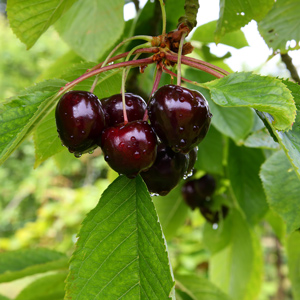
The fruit is large, with an average weight of 8–9 g, exceptionally uniform on the tree, and attractive in its large heart-shaped form with a long stem. The skin is firm, smooth, and distinctly glossy, intense dark red at harvest, turning beautiful dark burgundy to glossy coal-black at full technological maturity. The flesh is dark red, very firm, compact, and recognizably crisp, typical of a firm-fleshed sweet cherry, and moderately juicy. The taste is outstanding, rich, full, and dessert-like, characterized by high sugar content, fine refreshing acidity, and a recognizable, pleasant aroma. The stone is medium-sized and separates easily from the flesh.
It is characterized by exceptionally high genetic resistance of the fruit to cracking caused by heavy summer rains during the ripening period, which is its greatest commercial and cultivation advantage in the field, making it one of the safest varieties for growers in rainy years. It shows outstanding natural resistance of the wood and flower buds to harsh winter frosts and low temperatures during dormancy. It requires standard preventive chemical protection against Monilinia blossom and fruit rot, Monilinia laxa, as well as mandatory protection from birds, which are attracted by the dark crop.
The root system is exceptionally strong, deep, and branched. It uses moisture and nutrients from deeper layers very well and tolerates dry periods successfully in mature years, but it absolutely does not tolerate heavy, compacted, clayey, or waterlogged soils, where excess groundwater quickly causes root asphyxia, or suffocation, and decline of the entire tree. It requires deep, permeable, light, and fertile soils on well-ventilated sites.
Our sweet cherry fruit trees are produced on highly compatible, certified rootstocks: mahaleb cherry, Prunus mahaleb, and wild sweet cherry for classic and long-lived orchards on drier and skeletal soils. In addition to vigorous rootstocks, we also produce fruit trees on modern low- to medium-vigor vegetative rootstocks Gisela 5 and Gisela 6, which are the globally mandatory standard for this variety, as they ideally control its great natural vigor and upright growth, drastically accelerate entry into full bearing, as early as the second year, and enable the establishment of intensive, high-density commercial orchards with high profitability.