
Ferrovia
Ferrovia is a famous and highly valued Italian sweet cherry variety, discovered as a chance seedling of unknown origin in the Apulia region of southern Italy in the first half of the 20th century, during the 1930s. It was named because the first tree was found near a state railway line. Due to the beautiful, glossy appearance of the fruit, its exceptionally long post-harvest shelf life, large size, and premium flesh quality, it is the most popular commercial variety in Italy and one of the leading European sweet cherries for export and market production.
It is a fully cross-pollinated variety. It belongs to the IX sterility group and cannot set fruit with its own pollen, so the presence of compatible pollinator varieties flowering at the same time is essential in the orchard. It is distinctly genetically incompatible with the Italian variety Giorgia, as they share the same sterility group, making mutual pollination in the field impossible and resulting in a complete lack of crop. Since it flowers medium-late, its best, biologically synchronized, and field-proven pollinators are Kordia, Regina, and the self-fertile Sunburst. It flowers very abundantly and over a long period.
The tree is very vigorous, strong, and robust, with distinctly upright branch growth when young, later forming a large, wide, and well-branched canopy with strong scaffold branches. When grafted onto classic vigorous rootstocks, it enters full bearing somewhat later, around the fourth or fifth year after planting, which is why it gives perfect results on modern low-vigor rootstocks. Once it starts bearing, with suitable pollinators, it produces regular, stable, and very high yields. It requires strong winter and summer, or green, pruning, as well as proper bending and training of branches in the first two years in order to open the canopy.
It belongs to the group of medium-late to late sweet cherry varieties. In our region and under continental climatic conditions, it reaches harvest maturity in mid-June, usually between June 12 and 22, in the fifth week of the sweet cherry season, arriving only a few days before Kordia.
Harvesting takes place in mid- to late June. The fruit ripens fairly uniformly on the tree and is characterized by an exceptionally long, thin, and firm green stem, which significantly facilitates and speeds up hand picking while also reducing the risk of mechanical fruit damage. The fruit can remain on the branch for a very long time, even up to about ten days after full maturity, without any loss of firmness or gloss.
It is characterized by premium long-term storage ability. In fresh condition, it can be successfully kept in cold storage and controlled atmosphere storage for 2 to even 3 weeks while retaining full freshness. Due to its extremely firm, compact, and fleshy fruit, it tolerates picking, rough mechanical sizing, packing, and long-distance transport perfectly, without any risk of crushing or losing its recognizable high gloss. It is a leading premium table variety for late export and is used exclusively for luxury fresh table consumption on domestic and foreign markets.
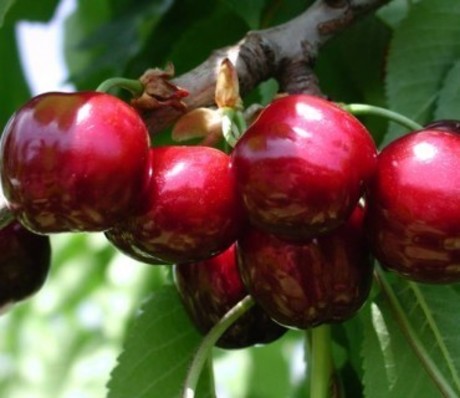
The fruit is very large to giant, with an average weight of 9–10.5 g and a caliber diameter exceeding 28–30 mm. It is uniform on the tree and attractive in its large elongated-heart-shaped to slightly ovate form, with a noticeable slight point at the tip. The skin is medium-thick, firm, elastic, smooth, and distinctly glossy, with a beautiful bright red to intense dark red color, never becoming overly dark or coal-black. The flesh is light red, very firm, compact, and recognizably crisp, typical of a firm-fleshed sweet cherry, exceptionally fleshy and juicy. The taste is outstanding, rich, and dessert-like, characterized by high sugar content perfectly balanced with mild and pleasant refreshing acidity, along with a rich varietal aroma. The stone is medium-sized.
It is moderately resistant to diseases. It shows excellent natural resistance of the wood and flower buds to low winter frosts during full dormancy. On the other hand, it is susceptible to fruit cracking caused by heavy and sudden summer rains during the ripening period, so in rainy June conditions it requires intensive preventive chemical protection against Monilinia and fruit rot, Monilinia laxa, as well as mandatory protection from birds, which are attracted by the large, glossy crop.
The root system is exceptionally strong, deep, and branched. It uses moisture and nutrients from deeper soil layers very well, but it absolutely does not tolerate heavy, compacted, clayey, or waterlogged soils with a high groundwater level, where lack of oxygen quickly causes root suffocation, or asphyxia, and decline of the entire tree. It requires deep, permeable, light, and fertile soils on well-ventilated sites.
Our sweet cherry fruit trees are produced on highly compatible, certified rootstocks: mahaleb cherry, Prunus mahaleb, and wild sweet cherry for classic and long-lived orchards on drier soils. In addition to vigorous rootstocks, we also produce fruit trees on modern low- to medium-vigor vegetative rootstocks Gisela 5 and Gisela 6, which are the globally mandatory standard for this variety, as they ideally control its great natural vigor, drastically accelerate entry into full bearing, as early as the second year, and enable the establishment of intensive, high-density, and highly profitable commercial orchards.