
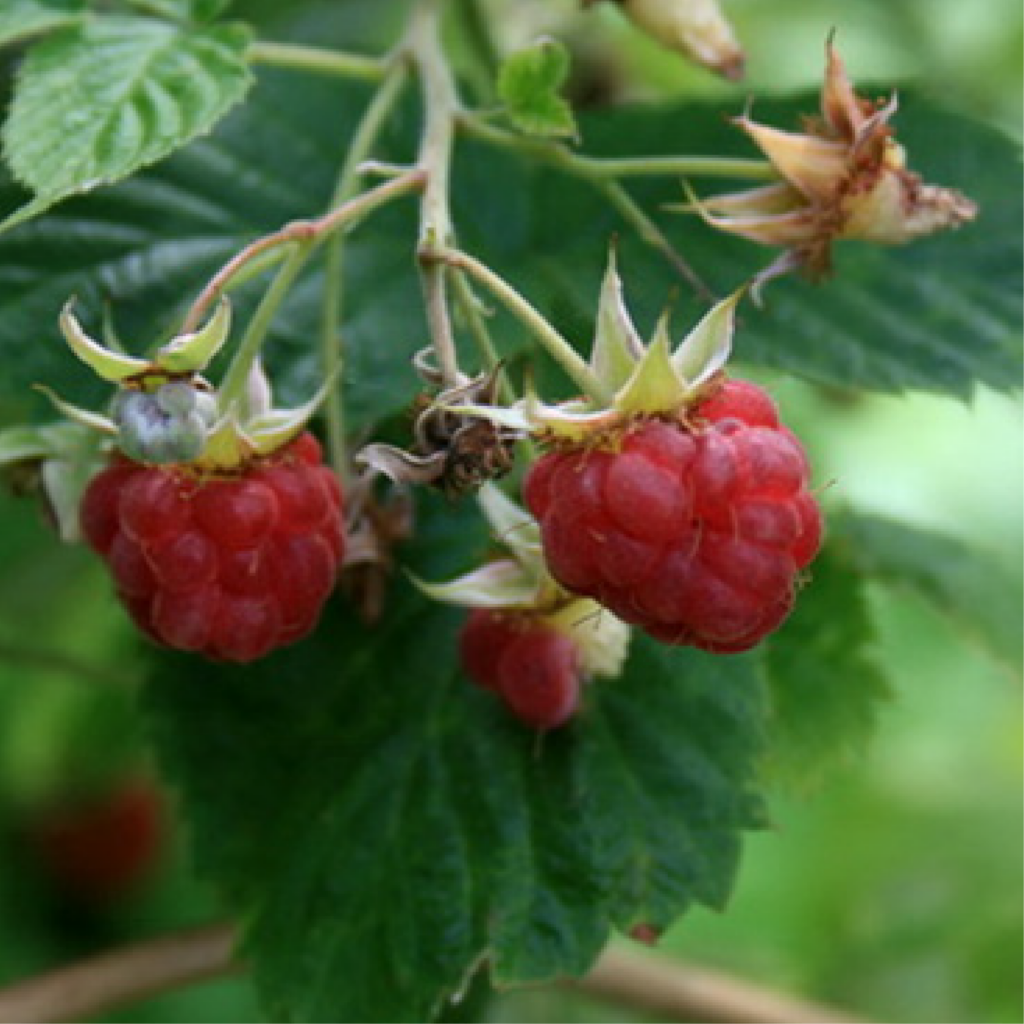
Meeker
Meeker originates from the USA, where it was developed at Washington State University, WSU, by the renowned breeder Dr. K. D. Schwartz, through planned crossing of Willamette and Cuthbert. It was released into wide commercial production in 1967. Due to the exceptional combination of extremely firm fruit, record-high sugar content, and high dry matter content, it is one of the most popular, most highly valued, and most profitable summer-bearing, floricane-fruiting raspberry varieties in the world. In our commercial plantations, it is positioned as a premium variety for demanding foreign markets.
It is a fully self-fertile variety. It is characterized by an exceptionally high level of self-pollination and abundant flowering on two-year-old canes, so it reliably, regularly, and stably produces maximum yields in pure single-variety plantations without any need for other varieties in the planting. It flowers medium-late, thanks to which its flower buds successfully and easily avoid late spring frosts.
The plant forms exceptionally long, vigorous, strong, and elastic canes that grow upright while young, with the upper parts bending slightly under the weight of the foliage. It is characterized by the formation of a large number of very long, strong lateral fruiting branches that carry an abundance of crop, which is why it requires a mandatory, stable, and strong support system, such as a trellis with 2 to 3 levels of wires, as well as precise thinning and tying of canes. It enters full bearing early and produces regular, stable, and very high yields per hectare.
It belongs to the group of medium-late summer raspberry varieties. In our region and under continental climatic conditions, it ripens at the end of June and during July, usually beginning to ripen 7 to 10 days after the standard Willamette variety.
Harvesting takes place during July and, due to the gradual, successive ripening of berries on long fruiting laterals, it can successfully last for 4 to 5 weeks. Due to the pronounced cohesion, or firmness, of the small drupelets within the fruit and the extremely easy separation from the receptacle at full maturity, it is one of the world’s leading varieties fully adapted both to hand picking and to mechanized harvesting with dedicated berry harvesters on large plots.
In fresh condition and in cold storage, it can be kept significantly longer than most other summer varieties, around 3 to 5 days. Due to its unique firmness, it tolerates picking, sorting, packing into plastic containers, and long-distance transport perfectly, without the risk of crushing or juice leakage, making it a favorite variety for fresh export. It has a record-high percentage of dry matter and sugar, which makes it highly valued and most sought-after in the industry for deep freezing, as it provides the highest percentage of luxury whole-fruit IQF “rolend” quality, with berries that do not crumble, as well as for the production of premium juices, jams, and confectionery products.
The fruit is medium-sized to large, with an average weight of 3.2–4.0 g, exceptionally uniform throughout the entire harvest, and attractive in its regular elongated-conical shape. The skin is firm, elastic, and glossy, and at full maturity it has a beautiful dark red to bright purple color that does not darken quickly after picking and storage. The flesh is extremely compact, fleshy, and juicy. The taste is fantastic, rich, and dessert-like, characterized by pronounced sweetness perfectly balanced with mild acidity and a luxurious, recognizable, and intense aroma of true raspberry.
It is moderately resistant to external factors. It shows excellent natural resistance of the canes to low winter temperatures, although in harsher winters without snow the very tips of the canes may partially suffer frost damage. It is highly sensitive to excess moisture and water retention in the root zone, which leads to plantation decline caused by root rot, Phytophthora, while in extremely rainy summers it requires preventive protection against gray mold of the fruit, Botrytis cinerea. It requires regular preventive chemical protection and proper agricultural practice.
The root system is surface-level, fibrous, and branched. It develops primarily in the upper arable soil layer and requires exclusively fertile, light, loose, moderately moist, and excellently drained soils, with mandatory installation of an irrigation system, preferably drip irrigation, during summer heat. It naturally forms a moderate to large number of root suckers, which successfully renew and rejuvenate the plantation every year.
We produce raspberry fruit seedlings exclusively vegetatively from strictly controlled and isolated nurseries. Certified / health-controlled planting material.