
President
President is a very old and globally popular English plum variety, developed at the end of the 19th century, in 1895, in Hertfordshire by the renowned and respected breeder Thomas Rivers, and released into wide production in 1901. Due to its giant fruit size, beautiful visual appearance, very late ripening season, and outstanding transportability, it is one of the most valued and profitable table plum varieties on the European and global market.
It is a fully cross-pollinated, self-sterile variety. It cannot set fruit with its own pollen, so the presence of compatible pollinator varieties that flower at the same time is essential in the orchard. Since it flowers very late in spring, its flowers easily avoid late spring frosts, and its best and field-proven pollinators are Stanley, Valor, and California Blue. Very early plum varieties, such as Čačanska Rana, cannot serve as pollinators due to a complete lack of overlap in flowering time.
The tree is very vigorous, strong, and robust, with a moderately dense, tall, and broad-pyramidal canopy characterized by distinctly upright branch growth at narrow angles. It enters the fruiting stage early if properly managed, usually in the third year after planting. Once it starts bearing, with adequate late-flowering pollinators, it produces regular, stable, and exceptionally abundant yields. Due to its distinctly upright branch growth and strong natural vigor, bending and training of young shoots during the first two years is essential, along with regular, stronger pruning in order to open the canopy.
It belongs to the group of very late autumn plum varieties. In our region and under continental climatic conditions, it ripens late, in the second half of September, usually between September 15 and 25, around 20 days after Stanley.
Harvesting takes place during the second half of September. One of the greatest advantages of this variety is that ripe fruit tolerates remaining on the tree very well and does not drop easily even in stronger winds, which significantly extends the harvest period for growers and allows fresh plums to be marketed at a time when most other varieties are no longer available.
It is characterized by premium and unsurpassed storage ability. In fresh condition, it can be successfully kept in cold storage for 3 to even 5 weeks, retaining full freshness, juiciness, and firmness. Due to its exceptionally firm, fleshy fruit and thick skin, it tolerates picking, rough mechanical sizing, packing, and long-distance transport perfectly, without any risk of crushing or juice leakage. It is a leading premium table variety for late export and fresh consumption, and it is also excellent for industrial freezing and home processing.
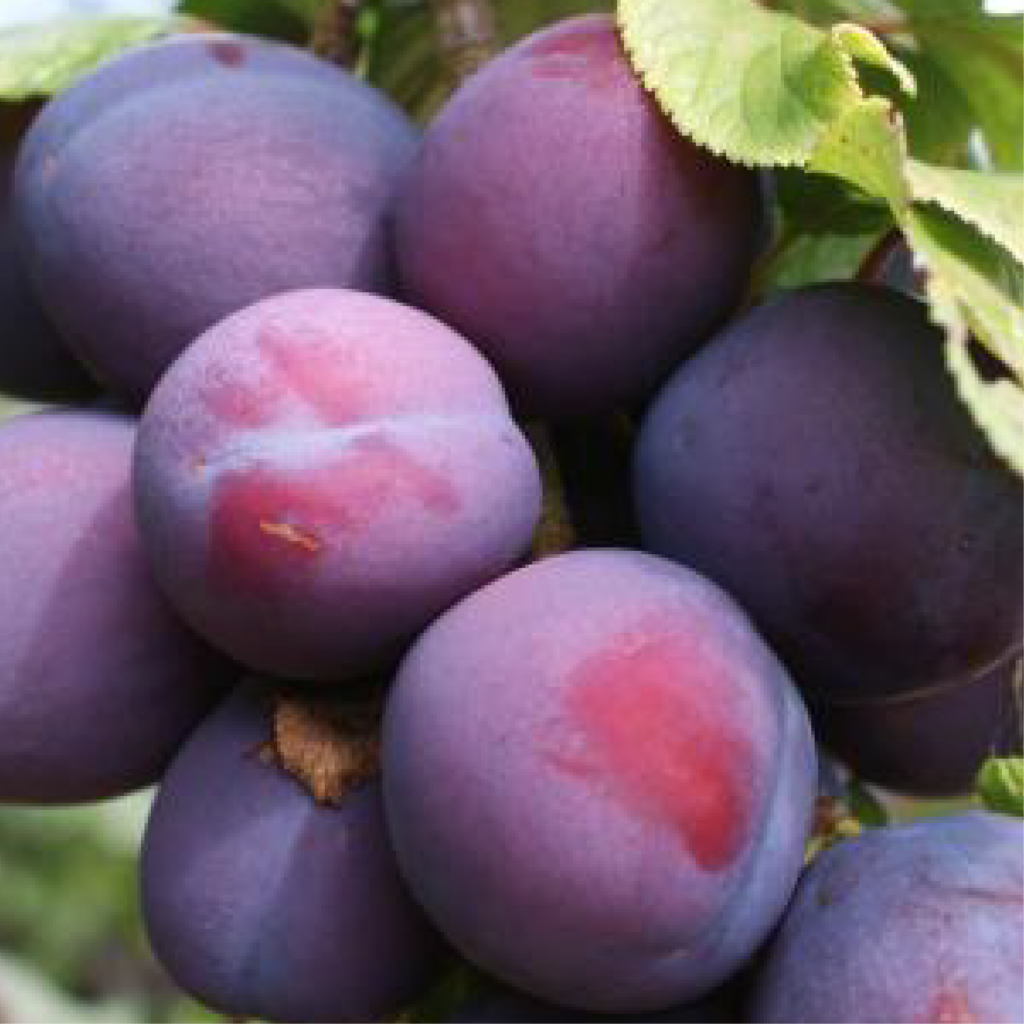
The fruit is exceptionally large to giant, with an average weight of 50 to over 65 g, while with excellent agricultural practice individual fruit easily reach weights of over 75 g. It is uniform on the tree and regular in shape, roundish-ovoid to elliptical, with a shallow groove. The skin is thicker, firm, and elastic, and at full maturity it has an attractive dark purple to dull steel-blue color, completely covered with a very dense, attractive, light blue waxy bloom. The flesh is light yellow to pale greenish, very firm, compact, fleshy, and moderately juicy. The taste is refreshing, sweet, with fine and pleasant acidity, while at full technological maturity it develops a delicate varietal aroma. The stone is relatively large, and the variety belongs to the group of true freestone plums: it separates from the flesh completely easily, smoothly, and cleanly.
It is a highly tolerant variety to Plum pox virus, which is a major cultivation advantage in the field. Even if the tree becomes infected, the virus does not cause fruit deformation or premature fruit drop, so it can be successfully grown in infected areas. It shows outstanding resistance of the wood and flower buds to harsh winter frosts. Due to the giant size and firmness of the fruit, in humid and rainy autumns before harvest it requires standard preventive chemical protection against Monilinia and fruit rot.
Our plum fruit trees are produced on the highly compatible, standard rootstock Myrobalan plum, Prunus cerasifera, with which this English variety achieves a perfect graft union, excellent tree longevity, and outstanding adaptability to different soil types.