
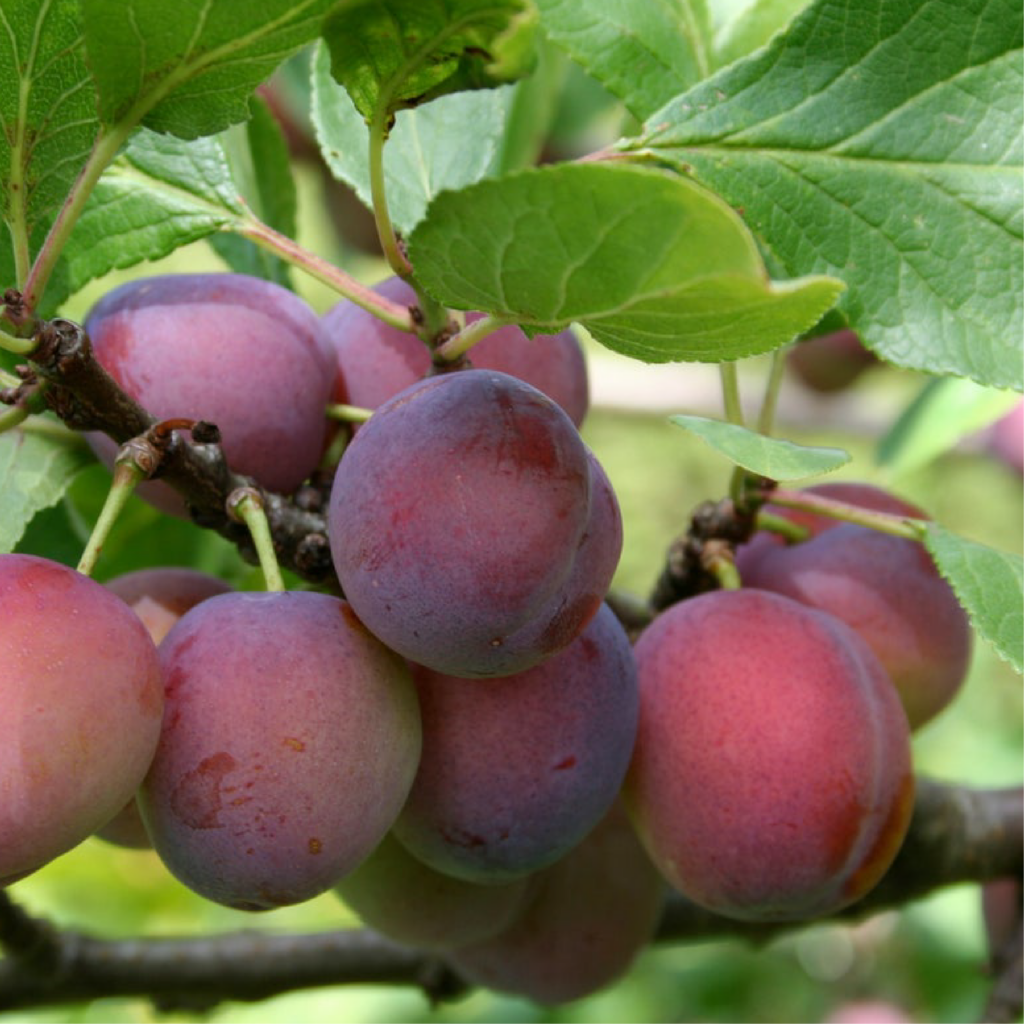
Opal
Opal originates from Sweden, where it was developed in 1946. at the prestigious Alnarp Institute through planned crossing of Oullins Gage and the early Swedish variety Early Favourite, and was officially released into production in 1958. Due to its premium dessert flavor, reminiscent of the finest green gages, and its very early ripening, it is considered the most popular and sought-after early summer plum variety throughout Northern, Central, and Western Europe.
It is a fully self-fertile variety. It is characterized by an exceptionally high percentage of self-pollination and stable, reliable fruit set with its own pollen, so it consistently produces maximum yields even when planted completely alone in single-variety blocks. Due to its abundant flowering and excellent pollen quality with strong germination capacity, Opal is an outstanding universal pollinator for almost all early and medium-early European plum varieties that flower at the same time. It flowers medium-early.
The tree is low to moderate, or medium, in vigor, with a neat, moderately dense, well-branched, and rounded canopy that is easy to train. It enters full bearing extremely early, often setting and producing its first fruit as early as the second year after planting. Once it starts bearing, it produces regular, stable, and very abundant yields per tree. Due to its inherent tendency toward overcropping, mandatory strong winter and summer pruning is required, along with hand thinning of the fruit in early summer, in order to prevent fruit size reduction and avoid the tree entering a phase of alternate bearing.
It belongs to the group of very early summer plum varieties. In our region and under continental climatic conditions, it ripens very early, in the first half to mid-July, usually between July 5 and 15, only a few days after the domestic variety Čačanska Rana.
Harvesting takes place during the first half of July. The fruit ripens gradually on the tree over a period of around ten days, allowing phased marketing. It is very important to harvest it on time and at technological maturity; fruit that overripens on the tree softens rapidly and is prone to massive premature drop in stronger winds.
Its fresh-storage ability is moderate and short, which is typical for early summer fruit. In cold storage, it can be successfully kept for only 7–10 days. Due to its more delicate and exceptionally juicy flesh, it is primarily intended for premium fresh table consumption immediately after harvest on the local market, while in home use it is excellent for making first summer jams, compotes, preserves, and aromatic plum brandy.
The fruit is medium-sized, with an average weight of around 30 g, and with excellent thinning it can reach up to 35 g. It is uniform on the tree and regular in shape, roundish-oval. The skin is thin, smooth, and delicate, initially yellow-green, while at full maturity it develops a very attractive reddish-violet to intense dark violet color, covered with a fine bluish waxy bloom. The flesh is golden-yellow to straw-yellow, moderately firm, compact, and extremely juicy and melting in the mouth. The taste is unsurpassed, rich, and full, characterized by a perfect balance of high sugar content and fine refreshing acidity, with a refined, noble, and pronounced gage-like varietal aroma. The stone is relatively small, and the variety belongs to the group of true freestone plums: it separates from the flesh completely easily, smoothly, and cleanly.
It shows exceptionally high tolerance to Plum pox virus, which is a major cultivation advantage in the field. Even if the tree becomes infected, the virus does not cause premature fruit drop or fruit deformation, so it can be grown successfully and safely in infected regions. It is characterized by outstanding resistance of the wood and flower buds to extremely low winter frosts and cold, inherited from its Swedish origin. On the other hand, the fruit skin is sensitive to cracking caused by heavy rainfall during ripening, so in humid July conditions it requires standard preventive chemical protection against Monilinia and fruit rot, as well as mandatory protection from wasps and birds.
Our plum fruit trees are produced on the highly compatible, standard rootstock Myrobalan plum, Prunus cerasifera, with which this Swedish variety achieves a perfect graft union, excellent tree longevity, and outstanding adaptability to different soil types.