
Excalibur
Excalibur originates from England, where it was created in 1970. as an open-pollinated seedling of the Cox’s Emperor variety at the Long Ashton Research Station. Due to its giant fruit size, beautiful and unique red-pink color, and unsurpassed, luxurious dessert-quality flesh, it is considered one of the most valued and best premium table plum varieties in the modern European assortment.
It is a fully cross-pollinated, self-sterile variety. It cannot set fruit with its own pollen, so the presence of compatible pollinator varieties that flower at the same time is essential in the orchard. The domestic varieties Čačanska Lepotica and Stanley have proven to be excellent and field-tested pollinators for this variety, as they overlap perfectly with it during the flowering stage. It flowers medium-early.
The tree is extremely vigorous, strong, and robust, with powerful scaffold branches that form a spacious, well-branched, and semi-spreading canopy with wide branch angles. It enters full bearing somewhat later compared to the autochthonous Čačak varieties, usually around the fourth year after planting, but once it starts bearing, with adequate cross-pollination, it produces regular, stable, and very good yields. Due to its strong natural vigor, bending and training of young shoots during the first two years is essential, along with regular pruning in order to control growth and stimulate productivity.
It belongs to the group of early summer plum varieties. In our region and under continental climatic conditions, it ripens very early, at the end of July and at the very beginning of August, usually between July 20 and August 1, at the same time as Čačanska Lepotica.
Harvesting takes place at the end of July and in early August. The fruit ripens fairly uniformly on the tree and is characterized by recognizable firmness, but it requires timely and careful hand picking in order to prevent overripening on the tree during summer heat.
Its fresh-storage ability is good for a summer plum. In cold storage, it can be successfully kept for 1–2 weeks. Due to its exceptionally firm, fleshy fruit and elastic skin, it tolerates picking, packing, handling, and transport very well, without the risk of crushing. It is primarily intended for luxury fresh table consumption on domestic and foreign markets, where it achieves a premium price due to its size and color, and it is also excellent for high-quality home processing, such as preserves and compotes.
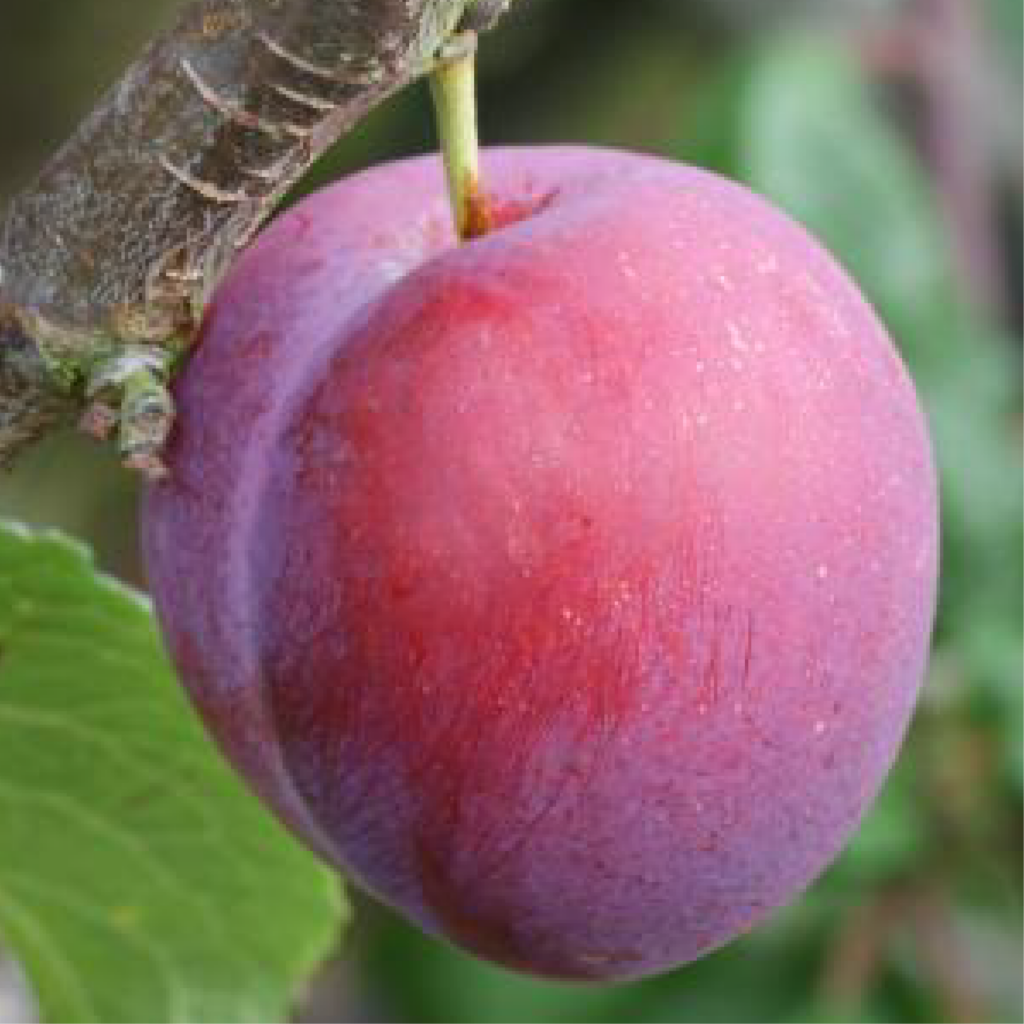
The fruit is exceptionally large to giant, with an average weight of 45 to over 55 g, while with excellent agricultural practice individual fruit easily reach over 65 g. It has a regular round to slightly roundish-oval shape. The skin is firm, smooth, and noticeably attractive, characterized by a beautiful reddish-orange to red-pink ground color, which at full maturity is covered with a fine light blue to violet waxy bloom. The flesh is orange-yellow, very firm, compact, juicy, and fleshy. The taste is outstanding, dessert-quality, distinctly sweet with a high sugar content, fine refreshing acidity, and a luxurious, refined aroma. The stone is relatively small, and the variety belongs to the group of true freestone plums: it separates from the flesh completely easily, smoothly, and cleanly.
It is a highly susceptible, even hypersensitive, variety to Plum pox virus, which is its greatest cultivation drawback in the field, a trait inherited from its parent variety Victoria. If the tree becomes infected, the virus causes severe fruit deformation and premature fruit drop, which is why orchards should be established exclusively in isolated and proven healthy regions, with mandatory use of completely healthy, certified planting material. It shows excellent resistance of the wood to low winter frosts and good moderate resistance to most fungal diseases of the foliage.
Our plum fruit trees are produced on the highly compatible, standard rootstock Myrobalan plum, Prunus cerasifera, with which this English variety achieves a perfect graft union, excellent tree longevity, and outstanding adaptability to different soil types.