
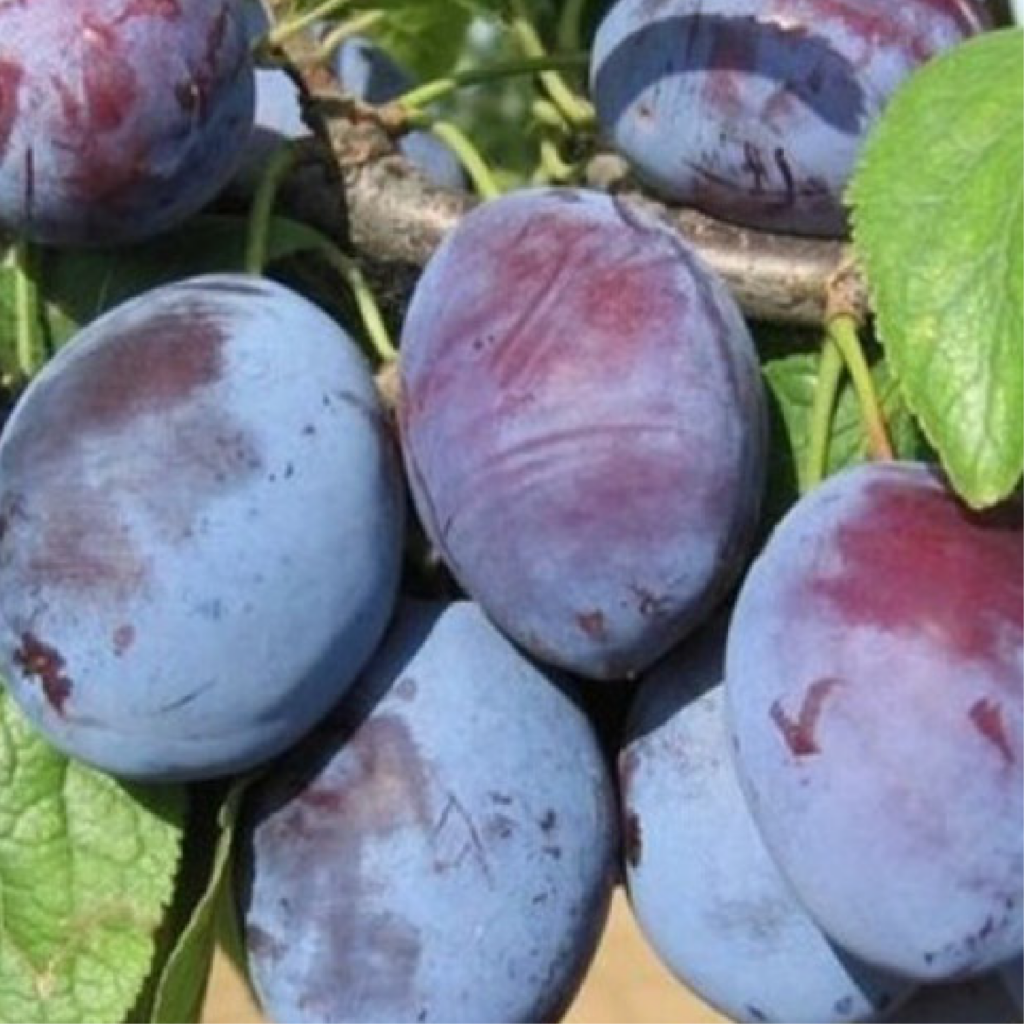
Cacanska lepotica
Čačanska Lepotica is a premium domestic plum variety, developed at the Fruit Research Institute in Čačak by Dr Staniša A. Paunović, Dr Milojko Ranković, and Dr Dobrivoje Ogašanović, and released into wide commercial production in 1975. It was created through planned crossing of Wangenheims Frühzwetsche and Požegača. Due to its early ripening, exceptional productivity, beautiful appearance, and premium table quality of the fruit, it is the economically most important, most widespread, and most sought-after early table plum variety throughout Europe and in our region.
It is a fully self-fertile variety. It is characterized by an exceptionally high level of self-pollination and stable, regular fruit set with its own pollen, so it reliably produces maximum yields in pure single-variety orchards without any need for other varieties in the orchard. Due to its early and abundant flowering, as well as extremely high-quality pollen with strong germination capacity, Čačanska Lepotica is the best universal pollinator in the world for all other plum varieties that flower at the same time, including Čačanska Rana and Čačanska Najbolja. It flowers medium-early.
The tree is naturally low to moderate, or medium, in vigor, with a moderately dense, regular rounded-pyramidal canopy and excellent wide branch angles that prevent tree damage. It enters full bearing extremely early, often producing its first commercial fruit as early as the second year after planting. It bears regularly, abundantly, and exceptionally stably every year. It is prone to overcropping, which is why mandatory, regular, and proper winter and summer pruning is required in order to thin the fruiting wood, prevent fruit size reduction, and avoid the tree entering a phase of alternate bearing.
It belongs to the group of early summer plum varieties. In our region and under continental climatic conditions, it ripens very early, at the end of July and in early August, usually between July 25 and August 5, around 3 to 4 weeks before Stanley.
Harvesting takes place at the end of July and in the first week of August. The fruit develops its recognizable intense blue color as early as ten days before the flesh reaches full technological maturity. For this reason, care must be taken not to harvest too early, while the flesh is still green and acidic, but rather at the stage when the fruit has developed its full, harmonious, and sweet taste.
It is characterized by exceptionally good storage ability for an early summer variety. In fresh condition, it can be successfully kept in cold storage for 2–3 weeks, which is an outstanding result. Due to its very firm flesh and elastic skin, the fruit tolerates picking, rough mechanical sizing, packing, and long-distance transport perfectly, without the risk of crushing or juice leakage. It is primarily a premium table variety for fresh consumption and export to demanding Western European markets, while in industry it is highly valued for deep freezing, cutting into halves, and for making high-quality homemade jams and thick plum preserves. For processing into plum brandy, it is used mainly secondarily, because it has a moderate sugar level and produces a solid distillate.
The fruit is medium-sized to large, with an average weight of 35–42 g, and with excellent pruning and thinning it can reach over 45 g. It is exceptionally uniform on the tree and regular in shape, roundish-oval, with a clearly pronounced longitudinal groove. The skin is firm and thin, dark blue to intense steel-blue, and completely covered with a very dense, attractive, light blue waxy bloom. The flesh is greenish-yellow, very firm, compact, juicy, and distinctly crisp. The taste is outstanding and refreshing, characterized by a perfect balance of sweetness and moderate acidity, with a mild and pleasant varietal aroma. The stone is medium-sized, and the variety belongs to the group of true freestone plums: it separates from the flesh completely easily, smoothly, and cleanly.
It is a highly tolerant variety to Plum pox virus, which is a major advantage in the field. Even if the tree becomes infected, the virus does not cause premature fruit drop or fruit deformation, so it can be grown safely and profitably in infected areas. It shows excellent resistance of the wood and flower buds to low winter frosts, as well as moderate resistance to blight and plum rust. On the other hand, it is highly susceptible to Monilinia and fruit rot, Monilinia fructigena, during humid summers before harvest, which requires mandatory and timely preventive chemical protection.
Our plum fruit trees are produced on the highly compatible, standard rootstock Myrobalan plum, Prunus cerasifera, with which this variety achieves a perfect graft union, excellent tree longevity, and outstanding adaptability to different soil types.