
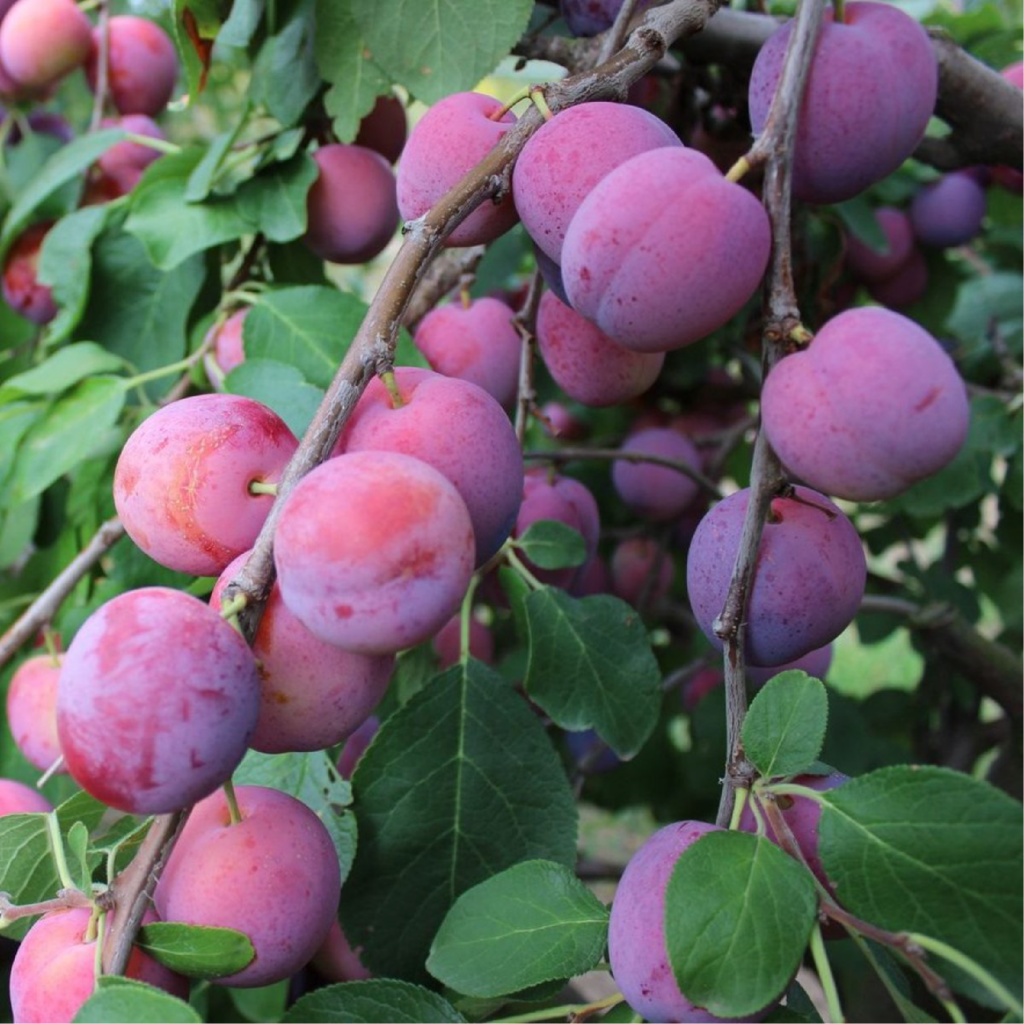
Avalon
Avalon originates from England, where it was developed in 1970. at the renowned Long Ashton Research Station in Bristol as an open-pollinated seedling of the old English variety Reeves, and was released into wide commercial production in 1989. It was selected with the primary aim of directly improving and replacing the famous European variety Victoria. Due to its exceptional fruit size, beautiful pink color, premium dessert quality, and significantly greater flesh firmness, it is considered one of the best modern table plum varieties.
It is a fully cross-pollinated, self-sterile variety. It cannot set fruit with its own pollen, so the presence of compatible pollinator varieties that flower at the same time is essential in the orchard. The domestic varieties Čačanska Lepotica, Stanley, and Victoria have proven to be excellent and field-tested pollinators for Avalon. It flowers medium-early, abundantly, and over a long period.
The tree is moderately vigorous to vigorous, with strong scaffold branches that form a well-branched, open, and moderately dense canopy. It enters full bearing somewhat more slowly in the first years after planting compared to the Čačak varieties, usually in the fourth year. However, once it starts bearing, with adequate cross-pollination, it produces abundant, stable, and high yields. It is prone to overcropping, which is why regular, stronger winter pruning and hand thinning of the fruit in early summer are essential in order to prevent branches from breaking under the weight of the crop and to avoid fruit size reduction.
It belongs to the group of medium-early summer plum varieties. In our region and under continental climatic conditions, it ripens in the first half to mid-August, usually between August 5 and 15, around 7–10 days before Victoria.
Harvesting takes place during the first half of August. The variety is characterized by fairly uniform fruit ripening on the tree, but selective and careful hand picking in two passes is recommended so that all fruit can develop ideal marketable skin color.
It is characterized by exceptionally good storage ability for a summer variety. In fresh condition, it can be successfully kept in cold storage for 2–3 weeks, which is a fantastic result. Due to its exceptionally firm, fleshy fruit and elastic skin, it tolerates picking, rough mechanical sizing, packing, and long-distance transport perfectly, without any risk of crushing or juice leakage. It is primarily a premium table plum for luxury fresh consumption and export, and it is also outstanding for making premium jams, preserves, and compotes.
The fruit is large to very large, with an average weight of 40 to over 50 g, uniform on the tree, and regular in shape, roundish-oval to slightly elongated. The skin is firm, smooth, and noticeably attractive, characterized by a beautiful pinkish-red to light violet color, which at full maturity is covered with a fine bluish waxy bloom. The flesh is orange-yellow to pale yellowish, very firm, compact, fleshy, and exceptionally juicy. The taste is outstanding and dessert-quality, characterized by a rich, full, and pronounced sweet note perfectly balanced with delicate and fine acidity in the skin itself. The stone is medium-sized, and the variety belongs to the group of true freestone plums: it separates from the flesh completely easily, smoothly, and cleanly.
It shows high overall resistance to most fungal diseases of the foliage, such as rust and blight, significantly better than older European plum varieties. On the other hand, it is a highly susceptible, even hypersensitive, variety to Plum pox virus, which is its greatest cultivation drawback in the field. If the tree becomes infected, the virus causes severe fruit deformation and premature fruit drop, which is why orchards should be established exclusively in isolated and proven healthy regions, with mandatory use of completely healthy, certified planting material. It shows excellent resistance of the wood to harsh winter frosts.
Our plum fruit trees are produced on the highly compatible, standard rootstock Myrobalan plum, Prunus cerasifera, with which this English variety achieves a perfect graft union, excellent tree longevity, and outstanding adaptability to different soil types.