
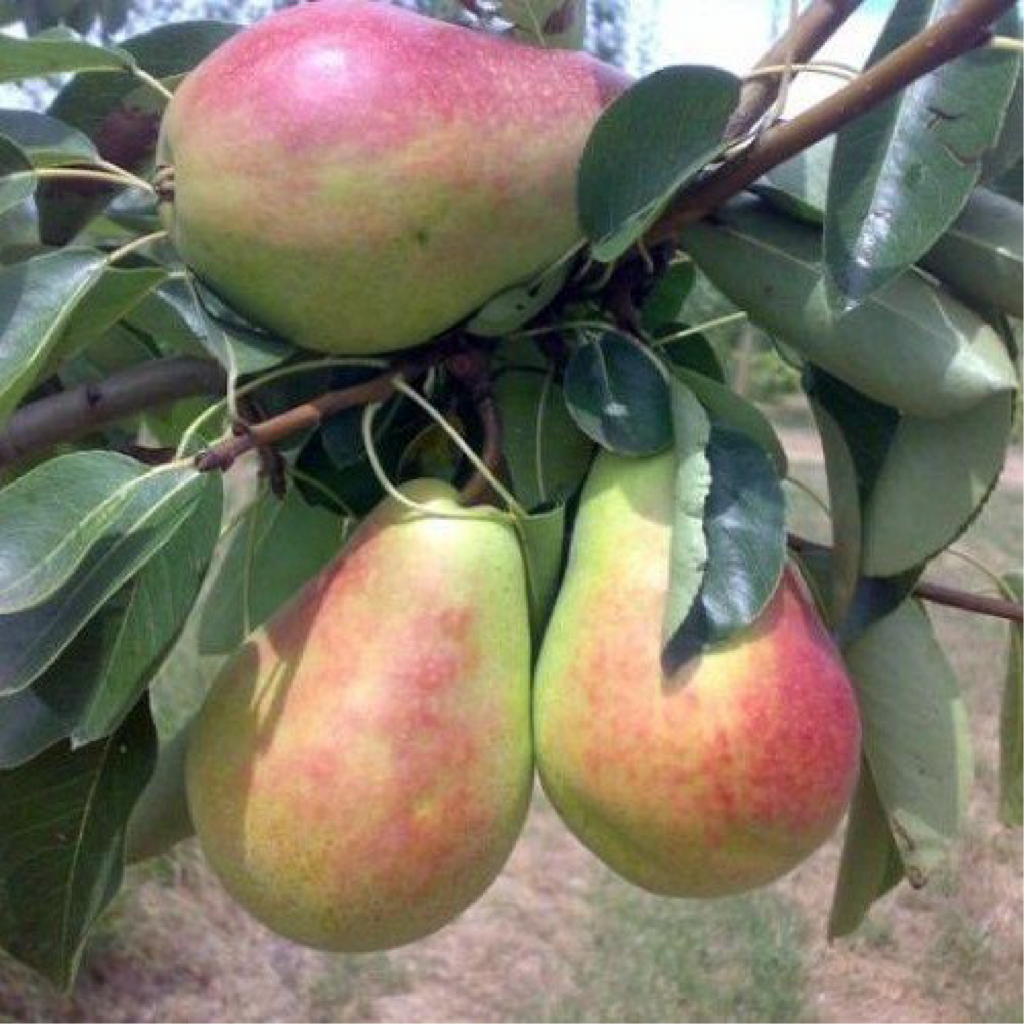
Early Morettini (Butirra Precoce Morettini)
Early Morettini, also known as Butirra Precoce Morettini, originates from Italy, where it was developed in the 1950s in Florence by the renowned Professor Elvio Morettini. It was created through a successful crossing of Coscia and Williams. Due to its very early ripening, exceptionally attractive fruit appearance with a beautiful bright red blush, and premium buttery flesh quality, it is one of the most valued and profitable early summer pear varieties on the market.
It is a fully cross-pollinated, self-sterile variety. It cannot set fruit with its own pollen, so the presence of compatible pollinator varieties that flower at the same time is essential in the orchard. Since it flowers early to medium-early, its best and field-proven pollinators are Williams, Santa Maria, Conference, and Giffard.
The tree is moderately to highly vigorous, with a regular, pyramidal, and medium-dense canopy supported by strong scaffold branches that form excellent branch angles. It enters the fruiting stage very early, often setting its first fruit as early as the second or third year after planting. Once it starts bearing, it produces regular, moderate to exceptionally good yields. It responds very well to standard pruning and requires moderate fruit thinning in early summer in order to maintain maximum fruit size.
It belongs to the group of very early summer pear varieties. In our region and under continental climatic conditions, it ripens very early, at the end of July and in early August, usually between July 20 and 30, around 20–25 days before the standard Williams variety.
Harvesting takes place in the second half of July, exclusively at the stage of technological maturity while the fruit is still completely firm. Timely harvesting is of crucial importance; due to high summer temperatures, fruit that overripens on the tree very quickly loses juice, becomes mealy, and is prone to internal flesh browning. Fruit harvested at the proper stage of maturity tolerates handling well.
Its storage ability is moderate and short, which is standard for all early summer pears. In standard cold storage, it successfully retains firmness and juiciness for only 2 to a maximum of 3 weeks. Due to its more delicate and melting flesh at full maturity, the fruit is less suitable for long storage and rough mechanical sizing, so it must be placed on the market shortly after harvest. It tolerates careful transport in shallow crates very well. It is primarily a premium table variety for the first summer fresh consumption, and it is also excellent for homemade compotes and juices.
The fruit is medium-sized to large, with an average weight of around 150–180 g, uniform, and regular, with an attractive pear shape and smooth surface. The skin is thin, smooth, and very glossy, yellow-green at harvest, turning lemon-yellow at full maturity. Its greatest aesthetic advantage is that the sun-exposed side, over more than 30–50% of the surface, is covered with an exceptionally attractive bright red blush and overcolor. The flesh is whitish-yellow, exceptionally juicy, finely buttery in texture, and completely melting in the mouth, typical of a melting butter pear, without coarse stone cells. The taste is outstanding, very refreshing and sweet, with a mild and pleasant varietal aroma.
It is a moderately resistant variety. It shows moderate resistance of the wood to winter frosts. It is susceptible to fire blight, Erwinia amylovora, pear scab on leaves and fruit, Venturia pyrina, and fruit rot on the tree during humid summers, which requires regular, professional, and timely preventive chemical protection throughout the growing season, as well as protection from wasps and birds attracted by the early sweet crop.
Our pear fruit trees are produced on highly compatible and certified rootstocks. Unlike Williams, Early Morettini has very good and naturally successful direct compatibility with quince, which is why in our nursery it is grafted directly, without an interstock, onto vegetative rootstocks Quince M-A and Quince BA-29, guaranteeing early entry into bearing and ideal growth control in intensive, higher-density orchards. It is also produced on the generative wild pear rootstock, Pyrus communis, for drier and heavier soils.