
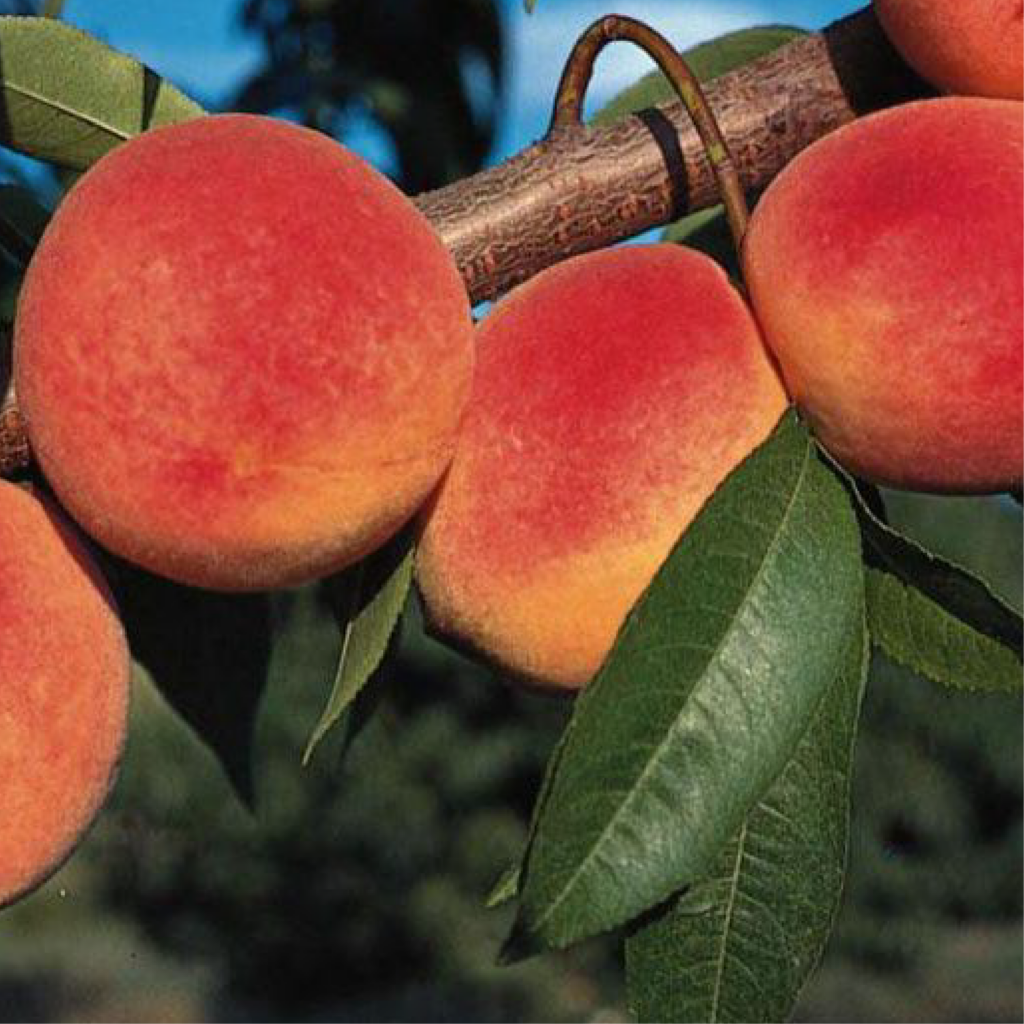
Redhaven
Redhaven is the best-known, most widely grown, and economically most important peach variety of all time, both worldwide and in our region. It was developed in 1940. at Michigan State University in the USA by the renowned breeder Stanley Johnston, through planned crossing of Halehaven and Kalhaven. Due to its exceptional adaptability to different soil types, premium flesh quality, and extreme frost resistance, it represents the pomological standard by which the flowering and ripening times of all other peach varieties in the world are determined.
It is a fully self-fertile variety. It is characterized by an exceptionally high level of self-pollination and very abundant. It is excellent as a universal pollinator for all other cross-pollinated peach varieties. It flowers medium-late, and its flower buds possess outstanding resistance to late winter and spring frosts.
The tree is moderate to medium in vigor, with a recognizable, attractive, well-branched, and wide canopy with excellent branch angles. It enters full bearing extremely early, often producing its first commercial fruit as early as the second year after planting. It bears regularly, abundantly, and extremely stably every year. Due to its inherent tendency toward overcropping, mandatory, strong, and regular winter pruning is required, along with rigorous hand thinning of the fruit in early summer, in order to prevent fruit size reduction and branch breakage under the weight of the crop.
It belongs to the group of medium-early summer peach varieties. In our region and under continental climatic conditions, it ripens in the very peak of summer, at the end of July and in early August, usually between July 25 and August 5.
Harvesting takes place at the end of July and during the first half of August. Since the fruit ripens gradually on the tree, harvesting in the orchard is carried out selectively and carefully, in 2 to 3 passes, choosing only ideally colored fruit.
In fresh condition, it can be successfully kept in cold storage for 1–2 weeks. Due to its firm flesh at the stage of technological maturity, it tolerates picking, sorting, packing, and transport very well, without the risk of crushing. It is primarily a premium table variety for fresh consumption on domestic and foreign markets, but it is also widely used for industrial processing, including premium compote halves, juices, jams, and deep freezing.
The fruit is large, with an average weight of 150–200 g, and with excellent thinning it can exceed 220 g. It is exceptionally uniform on the tree and regular in shape, with an attractive round form. The skin is moderately pubescent, finely velvety, with an intense yellow to golden-yellow ground color covered over more than 70–80% of the fruit surface by a beautiful, bright, glossy red to marbled blush on the sun-exposed side. The flesh is intense yellow, slightly reddish around the stone, firm, compact, exceptionally juicy, and melting. The taste is unsurpassed, rich, full, and dessert-quality, characterized by a perfect balance of high sugar content and fine refreshing acidity, with a luxurious varietal aroma. The stone is medium-sized. It belongs to the group of semi-freestone peaches: at full eating maturity on the tree, the stone separates easily and cleanly, while in earlier harvest stages or in dry years the flesh may partially adhere to the stone.
It is moderately resistant to diseases. It shows outstanding natural resistance of the wood and flower buds to extremely low winter temperatures, tolerating down to -24°C. On the other hand, it is highly susceptible to peach leaf curl, Taphrina deformans, and susceptible to Monilinia and fruit rot, Monilinia laxa, in humid and rainy years before harvest, which requires mandatory, professional, and maximally regular preventive chemical protection, including copper-based blue spraying at the bud swelling stage and targeted fungicides during flowering.
Our peach fruit trees are produced on highly compatible, certified rootstocks: vineyard peach seedling, an excellent standard for well-drained, warm, and moderately fertile soils, and the modern vegetative rootstock St. Julien A, which successfully controls tree vigor on heavier and wetter soils, ensuring a perfect and long-lasting graft union.