
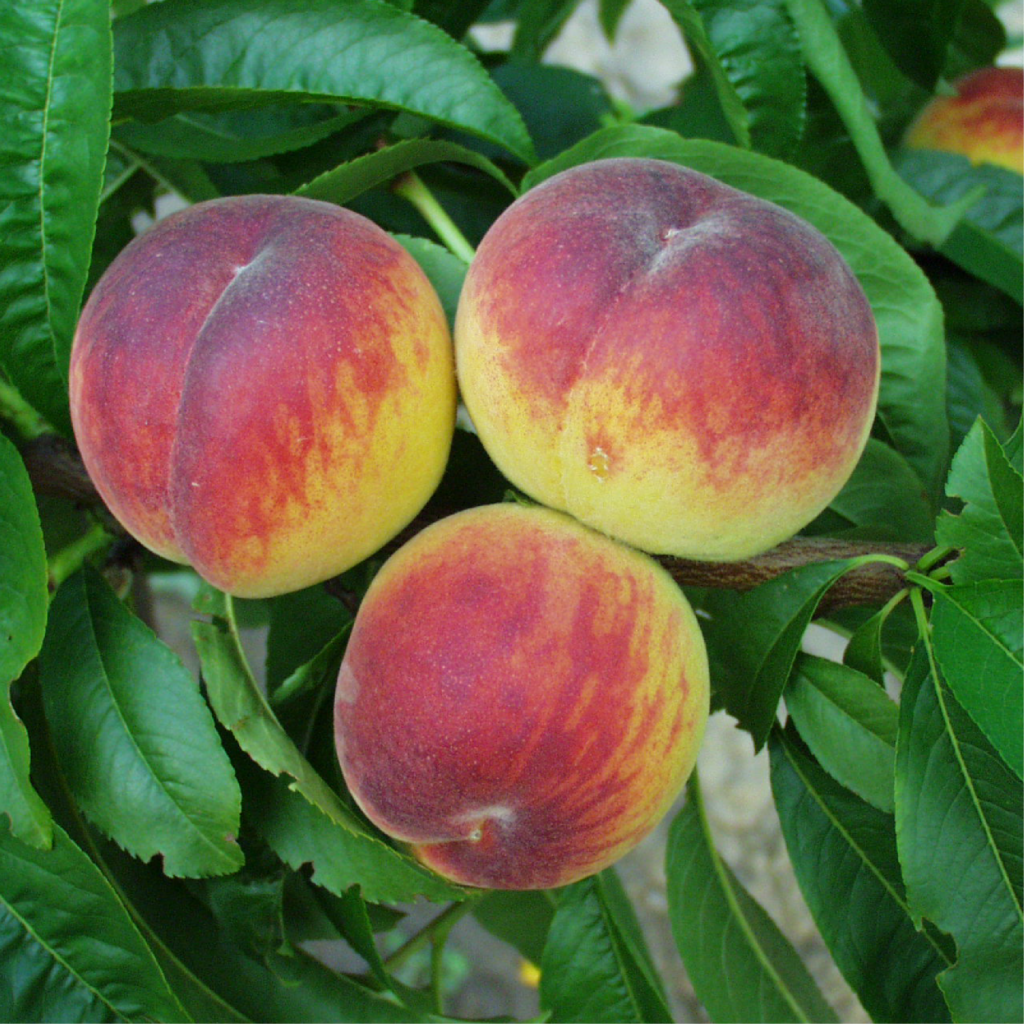
Dixired
Dixired originates from the USA, where it was developed in 1945. at the Experiment Station in Fort Valley, Georgia, through crossing of Halehaven and a self-pollinated seedling. Due to its very early ripening, high productivity, attractive bright red color, and unsurpassed flesh firmness for an early-ripening peach, it is one of the most popular, widely grown, and profitable early commercial varieties on both the global and domestic markets.
It is a fully self-fertile variety. It is characterized by an exceptionally high level of self-pollination and abundant flowering, so it reliably and stably produces maximum yields in pure single-variety orchards without the presence of other pollinator varieties. It is an excellent universal pollinator for all other peach varieties that flower at the same time. It flowers medium-late and is characterized by large, attractive rose-type, showy flowers whose buds are highly resistant to late winter and spring frosts.
The tree is moderately to highly vigorous, with robust scaffold branches that form a well-branched, wide, and medium-dense canopy with excellent branch angles. It enters full bearing very early, often producing its first commercial crop as early as the second or third year after planting. It bears regularly, abundantly, and exceptionally stably every year. Due to its tendency toward overcropping, mandatory strong winter and summer pruning is required, along with rigorous hand thinning of the fruit in early summer, in order to prevent fruit size reduction and avoid the tree entering alternate bearing.
It belongs to the group of early summer peach varieties. In our region and under continental climatic conditions, it ripens very early, in the first half of July, usually between July 5 and 15, around 20 days before the standard Redhaven variety.
Harvesting takes place during the first half of July. The fruit must be harvested selectively and in several passes, in 2 to 3 pickings, exclusively at the stage of technological maturity before it fully softens on the tree, thereby achieving the best market price at the beginning of the season.
Its fresh-storage ability is moderate, which is standard for all early summer peaches. In cold storage, it can be successfully kept for 5–7 days. Unlike older early varieties with soft and watery flesh, Dixired is characterized by exceptional compactness, which allows it to tolerate picking, sorting, packing, and careful transport very well, without the risk of crushing. It is primarily intended for the first luxury fresh table consumption on domestic and foreign markets.
The fruit is medium-sized to large for the early season, with an average weight of 130–150 g, and with excellent thinning it can reach over 170 g. It is uniform on the tree and regular in shape, with an attractive round form. The skin is thin, slightly and delicately pubescent, finely velvety, with an intense yellow to golden-yellow ground color covered over more than 80% of the fruit surface by a beautiful, bright, glossy red blush and stripes on the sun-exposed side. The flesh is intense yellow, without redness around the stone, exceptionally firm, compact, and fleshy in texture, and very juicy. The taste is outstanding and refreshing, characterized by a fine, pronounced sweet-acidic balance and moderate varietal aroma. It belongs to the group of true clingstone peaches: the flesh is firmly attached to the stone and does not separate from it even at full maturity.
It is moderately resistant to diseases. It shows excellent natural resistance of the wood and flower buds to low winter temperatures during dormancy. On the other hand, it is highly susceptible to peach leaf curl, Taphrina deformans, and susceptible to powdery mildew and fruit Monilinia in humid years, which requires mandatory, professional, and regular preventive chemical protection, including copper-based blue spraying at the bud swelling stage and targeted fungicides before and after flowering.
Our peach fruit trees are produced on highly compatible, certified rootstocks: vineyard peach seedling, an excellent standard for well-drained, light, and moderately fertile soils, and the modern vegetative rootstock St. Julien A, which successfully controls tree vigor on heavier and wetter soils, ensuring a perfect and long-lasting graft union.