
Fantasia
Fantasia originates from the USA, where it was developed in 1966. at the Research Center in Fresno, California, under the USDA breeding program by J. H. Weinberger and F. N. Harmon, and was released into wide commercial production in 1969. Due to its exceptional fruit size, beautiful appearance, and premium organoleptic qualities of the flesh, it is considered one of the highest-quality, most reliable, and most profitable yellow-fleshed nectarine varieties on both the global and domestic markets.
It is a fully self-fertile variety. It is characterized by a very high level of self-pollination and abundant flowering every year, so it reliably and stably produces maximum yields in pure single-variety orchards without the presence of other pollinator varieties in the orchard. It is an excellent universal pollinator for all other peach and nectarine varieties that flower at the same time. It flowers medium-late and is characterized by small, dark red, bell-shaped flowers whose buds are highly resistant to late winter cold and spring frosts.
The tree is highly vigorous, strong, and energetic in growth, with robust scaffold branches that form a wide, well-branched, and moderately dense canopy. It enters full bearing very early, often producing its first commercial crop as early as the second or third year after planting. It bears regularly, abundantly, and extremely stably every year. Due to its strong natural vigor and tendency toward excessive fruit set, mandatory strong winter and summer pruning is required, along with mandatory hand thinning of the fruit in early summer, in order to prevent fruit size reduction and branch breakage under the weight of the crop.
It belongs to the group of medium-late to late nectarine varieties. In our region and under continental climatic conditions, it ripens in the second half of August, usually between August 15 and 25, around two weeks after the standard Redhaven peach.
Harvesting is carried out selectively and in several passes during the second half of August. One of the greatest advantages of this variety is that ripe fruit tolerates remaining on the branches very well and does not drop easily even in stronger winds, allowing growers a stable and extended harvest during the late season.
It has excellent storage ability for a nectarine. In cold storage, it can be successfully kept for 1–2 weeks. Due to its exceptionally firm and compact flesh, it tolerates picking, rough mechanical sizing, packing, and long-distance transport perfectly, without any risk of crushing or juice leakage, making it a favorite variety among large retail chains and exporters. It is primarily intended for luxury fresh table consumption on domestic and foreign markets.
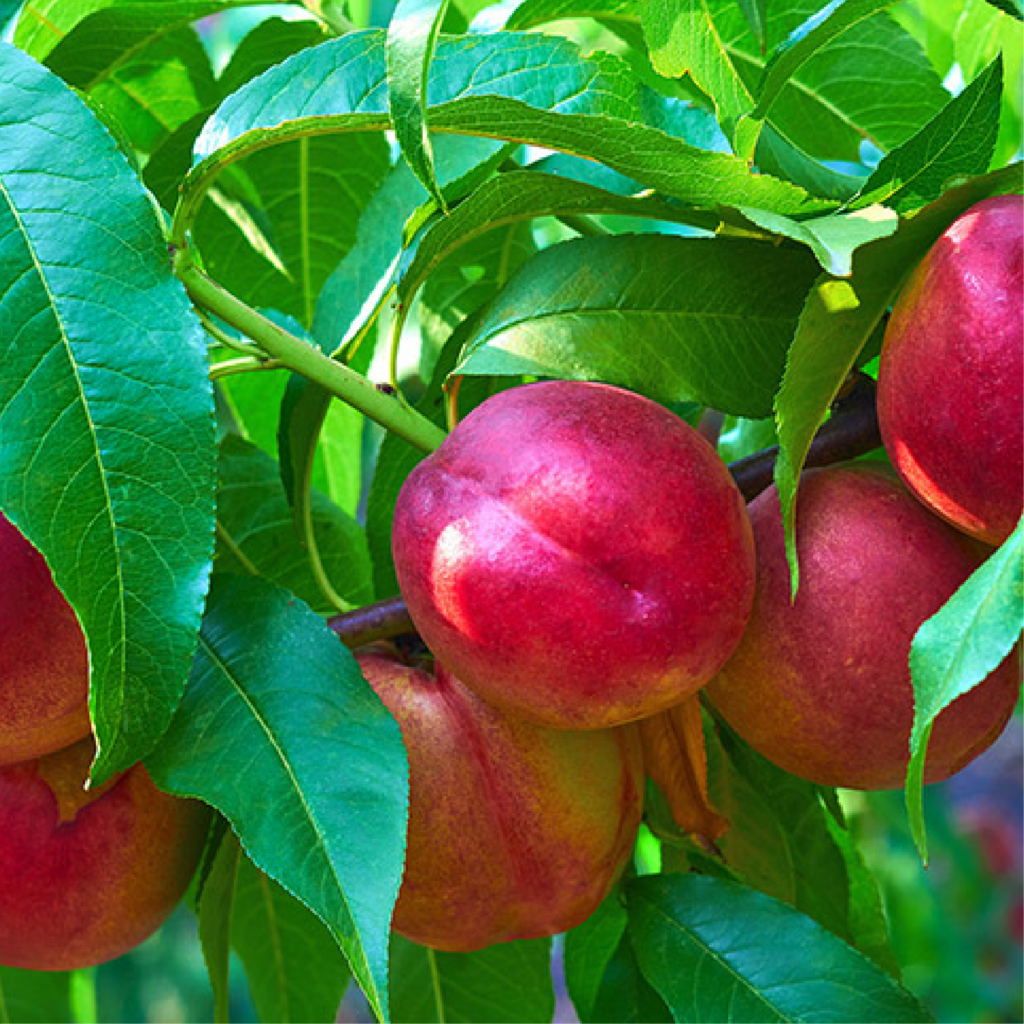
The fruit is large to very large, with an average weight of 160–200 g, while with excellent agricultural practice individual fruit easily reach over 230 g. It is uniform on the tree and regular in shape, attractive, roundish-oval to slightly elongated, with a weakly pronounced longitudinal groove. The skin is thin, firm, glossy, and completely smooth, without pubescence. The ground color is intense bright yellow, covered over more than 70–80% of the fruit surface by a beautiful, glossy dark red to bright red blush and overcolor on the sun-exposed side. The flesh is intense yellow, with slight redness around the stone, very firm, compact, juicy, and fleshy. The taste is outstanding, rich, and full, characterized by a pronounced sweet note perfectly balanced with a pleasant level of refreshing acidity and a luxurious varietal aroma. It belongs to the group of true freestone nectarines: the stone is medium-sized and, at full maturity, separates from the flesh completely easily, smoothly, and cleanly.
It is moderately resistant to diseases. It shows outstanding natural resistance of the wood and flower buds to low winter temperatures during dormancy. On the other hand, like all nectarines due to their smooth skin, it is highly susceptible to peach leaf curl, Taphrina deformans, and susceptible to Monilinia and fruit rot, Monilinia laxa, in humid and rainy years before harvest, which requires mandatory, professional, and maximally regular preventive chemical protection, including copper-based blue spraying at the bud swelling stage and targeted fungicides throughout the growing season.
Our nectarine fruit trees are produced on highly compatible, certified rootstocks: vineyard peach seedling, an excellent standard for well-drained, light, and moderately fertile soils, and the modern vegetative rootstock St. Julien A, which successfully controls tree vigor on heavier and wetter soils, ensuring a perfect and long-lasting graft union.