
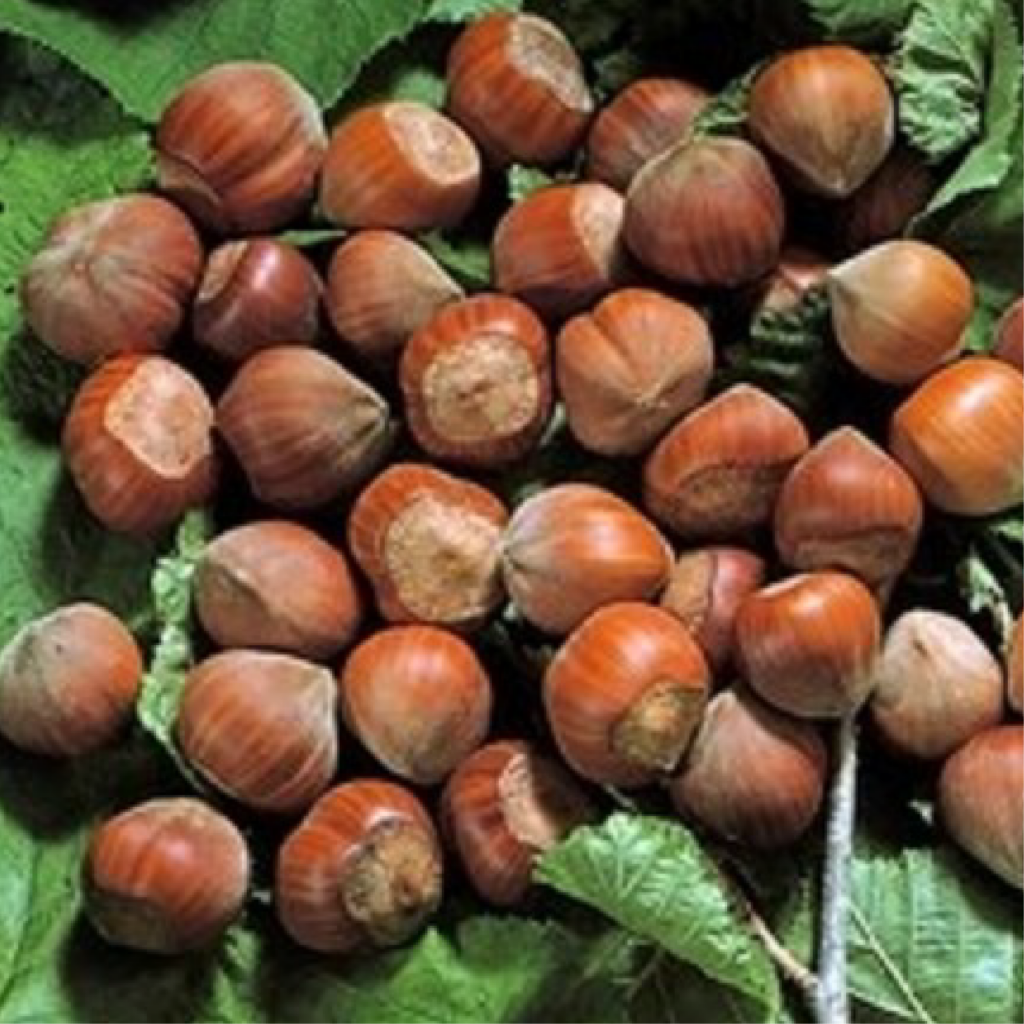
Istrian round
Istrian Round is a very old, traditional, and highly valued hazelnut variety originating from Istria. Due to its high adaptability to harsh continental conditions, large nut size, and stable productivity, it is one of the most widespread and popular hazel varieties throughout the Balkans and in our region. In modern orchards, it is planted as a leading table variety or as an indispensable companion to late-flowering varieties.
It is a fully cross-pollinated variety with pronounced protandry. It cannot set fruit with its own pollen, so the presence of compatible pollinator varieties in the orchard is essential. Since it flowers very late in spring, with its female flowers opening significantly later than those of most other European varieties, early-flowering varieties such as Istrian Long cannot successfully pollinate it. The best, biologically synchronized, and field-proven pollinators for Istrian Round are Roman hazelnut, Hall’s Giant, and Nocchione.
It grows as a shrub of moderate to high vigor, naturally forming a moderate number of basal shoots, which makes maintenance easier. When grafted, it develops as an elegant tree with an attractive, spacious, and semi-spreading canopy. It enters the fruiting stage very early, in the third year after planting. Once it starts bearing, it produces regular, stable, and very abundant yields every year. It responds very well to standard pruning aimed at improving light penetration inside the canopy.
It belongs to the group of medium-late hazelnut varieties. In our region and under continental climatic conditions, it ripens at the end of August and during the first half of September.
Harvesting takes place at the end of summer. Unlike varieties with a long husk, the major advantage of Istrian Round is its short, open husk, or involucre, from which the mature nut falls out completely easily and naturally to the ground at full maturity. This botanical trait greatly facilitates, speeds up, and reduces the cost of mechanical nut collection from the ground using vacuum harvesters, without the need for subsequent husking.
In a dry, cool, and well-ventilated space, unshelled nuts can be stored successfully for 6 to even 12 months without any loss of quality. In the shell, they retain an ideal moisture level and freshness for considerably longer than when shelled.
The nut is large to very large, with an average weight of around 3.5–3.8 g, exceptionally uniform, and recognizable by its attractive rounded to slightly spherical shape. The shell is firm, pale chestnut to darker brown in color, with pronounced darker longitudinal stripes. The kernel is large, light-colored, compact, sweet, and very rich in oils. It has a moderate kernel ratio of around 38–41% and a coarser fibrous pellicle that is more difficult to remove by blanching, which is why it is primarily intended for premium table consumption, in-shell sales, bulk sales, and home roasting, while in industrial processing it is used secondarily.
It is a moderately resistant variety. It shows outstanding natural resistance of the wood and flower buds to extremely low winter temperatures and late spring frosts, making it ideal for frost-prone sites and plains. In humid and rainy years, it requires preventive protection against hazelnut Monilinia fruit rot, Monilinia coryli, rust, and hazelnut bacteriosis, while among pests the greatest threats are the hazelnut weevil, Balaninus nucum, and phytophagous stink bugs, whose punctures cause the appearance of empty nuts, requiring timely protection.
The root system is surface-level and distinctly fibrous when grown from its own shoot, as a shrub, so regular irrigation is required during dry summers. On the other hand, when grafted onto Turkish hazel rootstock, it develops an exceptionally deep, powerful taproot that tolerates prolonged summer droughts extremely well and stabilizes the tree on windy sites.
Our hazelnut plants are produced in two premium forms: as trained one- or two-year-old own-rooted shoots for bush-form cultivation, or as highly sought-after grafted hazelnuts on Turkish hazel rootstock, Corylus colurna, for tree-form cultivation, which guarantees the absence of troublesome basal shoots, easier inter-row cultivation, and long orchard life.