
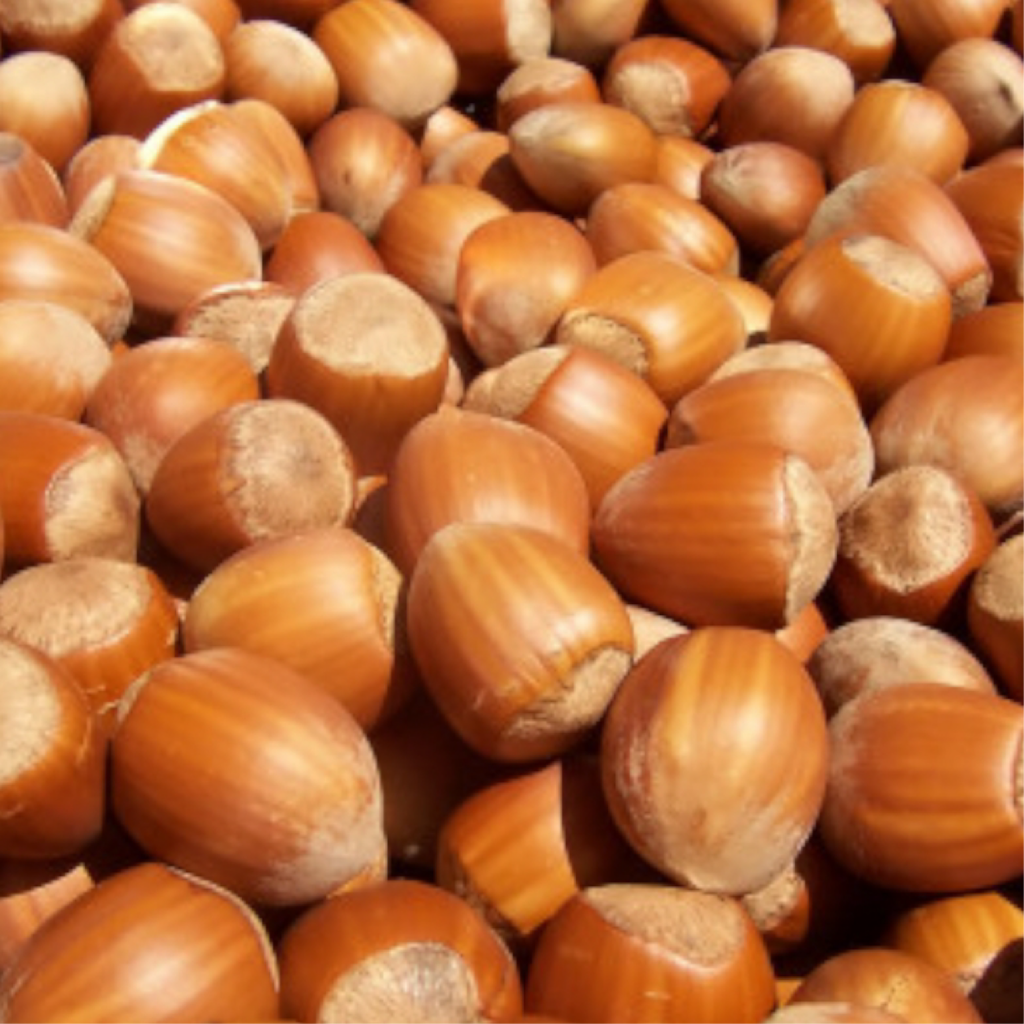
Istrian long
Istrian Long is a very old, traditional, and globally known hazelnut variety originating from Istria. Due to its exceptional and regular productivity, large fruit size, and excellent adaptability to our continental and hilly climatic conditions, it is one of the most popular, most widespread, and most sought-after hazel varieties in Serbia and throughout the Balkans.
It is a fully cross-pollinated variety with pronounced dichogamy. It cannot set fruit with its own pollen, so the presence of compatible pollinator varieties in the orchard is essential. Since it flowers very early in spring, with female and male flowers opening before those of most other varieties, its best, biologically synchronized, and field-proven pollinators are Istrian Round, Cosford, and Lambert. Late-flowering varieties, such as Roman hazelnut, cannot serve as primary pollinators due to a significant lack of overlap in the flowering stages.
It grows as a vigorous, strong, and branched shrub that naturally tends to form a large number of basal shoots. When grafted, it develops as an elegant single-trunk tree of medium vigor, with an attractive and spacious canopy. The variety is highly vital and long-lived, enters the fruiting stage early, as early as the third year after planting, and once it starts bearing, it produces regular, stable, and very abundant yields. It responds very well to standard pruning aimed at improving light penetration inside the canopy.
It belongs to the group of medium-early hazelnut varieties. In our region and under continental climatic conditions, it ripens at the end of August and in early September.
Harvesting takes place at the end of summer. The main pomological characteristic of this variety is its exceptionally elongated, fleshy husk, or involucre, which is noticeably longer than the nut itself and holds it tightly. Due to this botanical trait, mature hazelnuts rarely fall to the ground on their own; instead, they are collected by hand from the tree, shaken mechanically, or harvested together with the entire husk, after which additional mechanical husking, or removal of the involucre, is required.
In a dry, well-ventilated, and cool space, unshelled nuts can be stored successfully for 6 to even 12 months without any loss of quality, while shelled kernels kept in suitable packaging retain freshness for months.
The nut is large to very large, with an average weight of around 3.5 g, uniform, and characteristic in its distinctly elongated, cylindrical shape. The shell is medium-thick, firm, and pale light brown to striped brown in color. The kernel is large, elongated, compact, and very fleshy. The taste is outstanding, sweet, full, rich in oils, and with a luxurious aroma. It has a moderate kernel ratio of around 40–43% and a coarser dark brown pellicle that is harder to remove by roasting, which is why it is primarily intended for premium table consumption in fresh and dried form, either sold in shell or in bulk, while in the confectionery industry it is used secondarily.
It is a moderately resistant variety. It shows excellent natural resistance of the wood and flower buds, or catkins, to extremely low winter temperatures and spring frosts. In humid and rainy years, it may show moderate susceptibility to hazelnut bacteriosis, Xanthomonas corylina, while among pests the greatest threat is the hazelnut weevil, Balaninus nucum, which requires regular and timely preventive protection.
The root system is surface-level, shallow, and distinctly fibrous when hazel is grown from its own shoot, as a shrub, which is why in the first years it requires sufficient moisture and irrigation during summer droughts. On the other hand, when grafted onto Turkish hazel rootstock, it develops an exceptionally deep, powerful taproot that tolerates dry periods very well and stabilizes the tree.
Our hazelnut plants are produced in two premium forms: as trained one- or two-year-old own-rooted shoots for bush-form cultivation, or as highly sought-after grafted hazelnuts on Turkish hazel rootstock, Corylus colurna, for tree-form cultivation, which guarantees the absence of troublesome basal shoots, easier mechanical cultivation, and long orchard life.