
Hall’s Giant
Hall’s Giant, also known as Hallesche Riesen, is a very old, traditional, and highly popular German hazelnut variety, selected in 1788. in Halle, Germany. Due to its giant nut size, unsurpassed resistance of the wood and catkins to low winter temperatures, and abundant productivity, it is one of the most widespread and commonly planted companion varieties in modern orchards and home gardens throughout Europe and the Balkans.
It is a fully cross-pollinated variety with pronounced protandry. It cannot set fruit with its own pollen, so the presence of compatible pollinator varieties in the orchard is essential. Since it flowers very late in spring, it requires pollinators that also flower late. It is distinctly incompatible with the Cosford variety, as they share the same sterility alleles and cannot pollinate each other. The best, biologically synchronized, and field-proven pollinators for Hall’s Giant are Roman hazelnut, Istrian Round, and Nocchione. The variety itself produces pollen with moderately weak germination capacity, so it is planted in orchards primarily for the premium size of its nuts.
It grows as a very vigorous, strong, and robust shrub with moderately upright growth, naturally forming a larger number of basal shoots. When grafted, it develops into an exceptionally strong, stable, and long-lived tree with a beautiful, wide, and well-branched canopy. It enters the fruiting stage early, as early as the third year after planting. Once it starts bearing, it produces regular, stable, and exceptionally high, abundant yields every year. It responds very well to standard pruning aimed at improving ventilation and light penetration inside the canopy.
It belongs to the group of late hazelnut varieties. In our region and under continental climatic conditions, it ripens during September, most often in the first half of September.
Harvesting takes place during September. A major pomological advantage of this variety is its short, bell-shaped husk, or involucre, which is open and level with the nut. Due to this botanical trait, at full autumn maturity the large nuts fall out of the husk completely easily and naturally, dropping massively to the ground, which greatly facilitates, speeds up, and reduces the cost of mechanical collection with vacuum harvesters, without the need for subsequent cleaning.
In a dry, cool, and well-ventilated space, unshelled nuts can be stored successfully for 6 to even 12 months without any loss of quality. Thanks to the thick and firm shell, the kernel is perfectly protected from external influences and moisture loss.
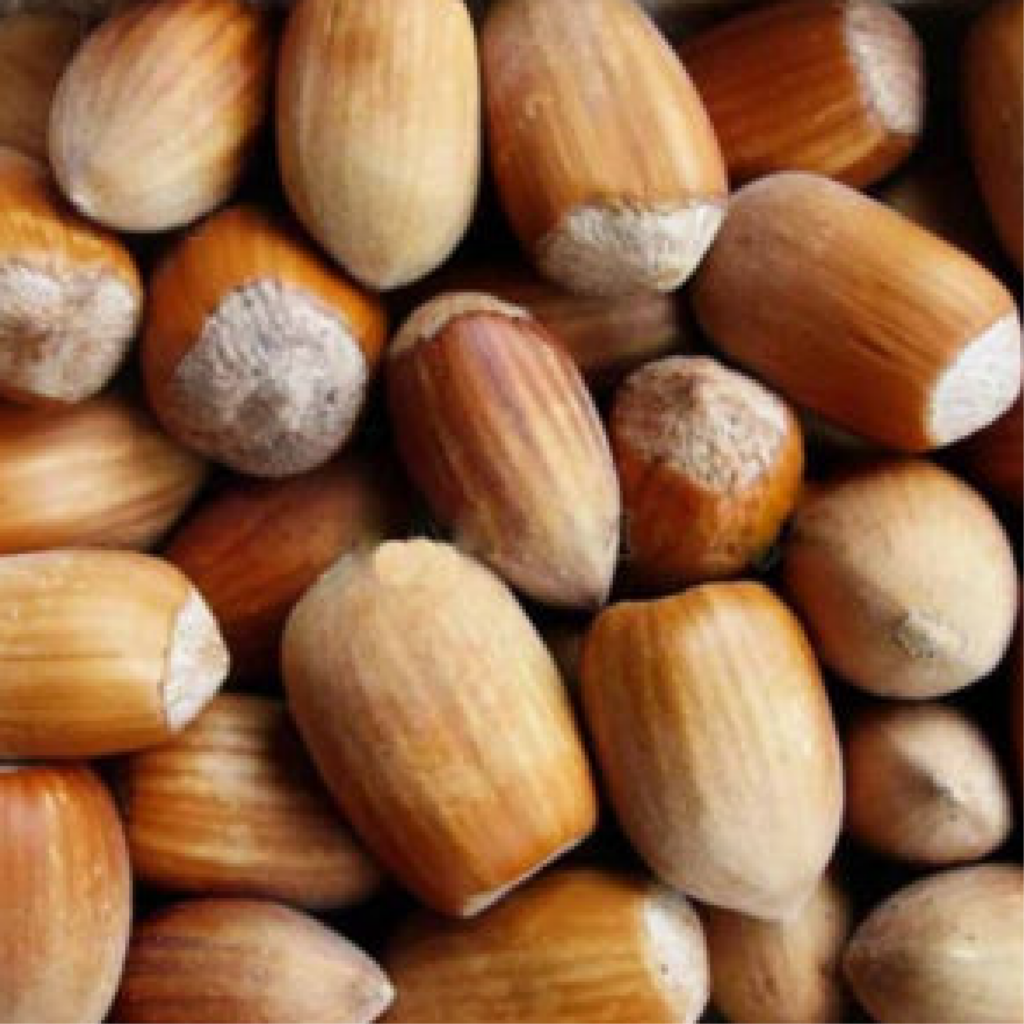
The nut is very large to giant, with an average weight of 3.5 to over 4.2 g, and with excellent agricultural practice individual nuts can reach even greater weights. It is uniform on the tree and recognizable by its attractive roundish-conical shape. The shell is thick, extremely firm, and smooth, light brown to dark brown in color, with pronounced darker longitudinal stripes. The kernel is large, light cream-colored, compact, sweet, and very fleshy, with a pleasant and full taste. It has a lower industrial kernel ratio of around 35–38% and a coarse fibrous pellicle that is more difficult to remove after roasting, which is why it is primarily and unquestionably intended for premium table consumption, in-shell sales, bulk sales, and home roasting, while confectionery giants avoid it for industrial creams.
It is characterized by outstanding genetic resistance to extremely low winter frosts and low temperatures, inherited from its German origin, and thanks to its late flowering, its female flowers easily avoid late spring frosts. It is an ideal variety for regions with harsh continental climates and frost-prone sites. It shows good resistance to diseases and hazelnut bud mite, Phytoptus avellanae, while among pests the greatest threat is the hazelnut weevil, Balaninus nucum, which requires standard preventive protection.
The root system is surface-level and fibrous when grown from its own shoot, as a shrub, so irrigation is required during dry summers. When grafted onto Turkish hazel rootstock, however, it develops an exceptionally deep, powerful taproot that tolerates prolonged summer droughts extremely well and provides high stability for the robust tree.
Our hazelnut plants are produced in two premium forms: as trained one- or two-year-old own-rooted shoots for bush-form cultivation, or as highly sought-after grafted hazelnuts on Turkish hazel rootstock, Corylus colurna, for tree-form cultivation, which guarantees the absence of troublesome basal shoots, easier inter-row cultivation, and long orchard life.