
Michele Palieri
Michele Palieri is a premium black table grape variety, created in Italy at the experimental center in Velletri, near Rome, by the well-known Italian breeder after whom it was named. It was selected in 1958, and after several years of testing it was officially registered and released into production in 1975. It was developed through the planned and successful crossing of Alphonse Lavallée and Molinera (VIVC). Due to its exceptional, giant cluster size, beautiful visual appearance, pronounced flesh crispness, and fantastic resistance to transport and storage, it is one of the most profitable, most widespread, and most sought-after black table grape varieties on the entire European and global market.
It is a fully self-fertile variety. The flower is morphologically hermaphroditic, properly developed and bisexual, with an exceptionally high and stable level of self-pollination and abundant, viable pollen. This ensures perfect and uniform berry set within the cluster, without a pronounced tendency toward flower shatter or undesirable millerandage, even in unfavorable, cooler springs. It flowers medium-early.
The vine is exceptionally vigorous, with very strong and robust vegetative growth, producing thick, powerful, dark brown shoots that carry large, five-lobed leaves of intense green color. It requires the mandatory installation of a strong, high, and stable training structure, including posts and multi-row wires. It gives excellent commercial results primarily on high training systems such as pergolas, arbors, tendones, and cordon systems, where its great natural strength and large vegetative mass can be more easily controlled and distributed. It enters full bearing early after planting grafted grapevines and produces regular, stable, and exceptionally high yields per vine. It requires mixed or long pruning, leaving canes with 10 to 12 buds, in order to achieve maximum yield, because the lowest, basal buds on the shoot are naturally moderately less productive.
It belongs to the group of medium-late table grape varieties. In our region and under continental climatic conditions, it ripens in the first half of September, usually between September 5 and 15, in the fifth week of grape ripening, arriving about ten days before Muscat Hamburg and around one month after the early summer variety Cardinal.
Harvesting takes place during September. The clusters ripen uniformly on the vine and are characterized by a recognizable, thick, and exceptionally strong green pedicel that firmly holds the heavy berries. One of the greatest ampelographic advantages of this variety is that the clusters can remain on the vine for a very long time after full ripening without berry drop and without any loss of flesh firmness or quality.
It is characterized by exceptionally good post-harvest storage ability. In modern cold storage facilities and controlled conditions, it can be successfully kept for 1 to even 2 months without any loss of freshness or bruising. Due to its very thick, elastic skin and firm flesh, it tolerates picking, sorting, mechanical sizing, packing into crates, and long-distance transport perfectly, without any risk of fruit crushing or juice leakage. It is a leading premium black variety for mass export to distant foreign markets.
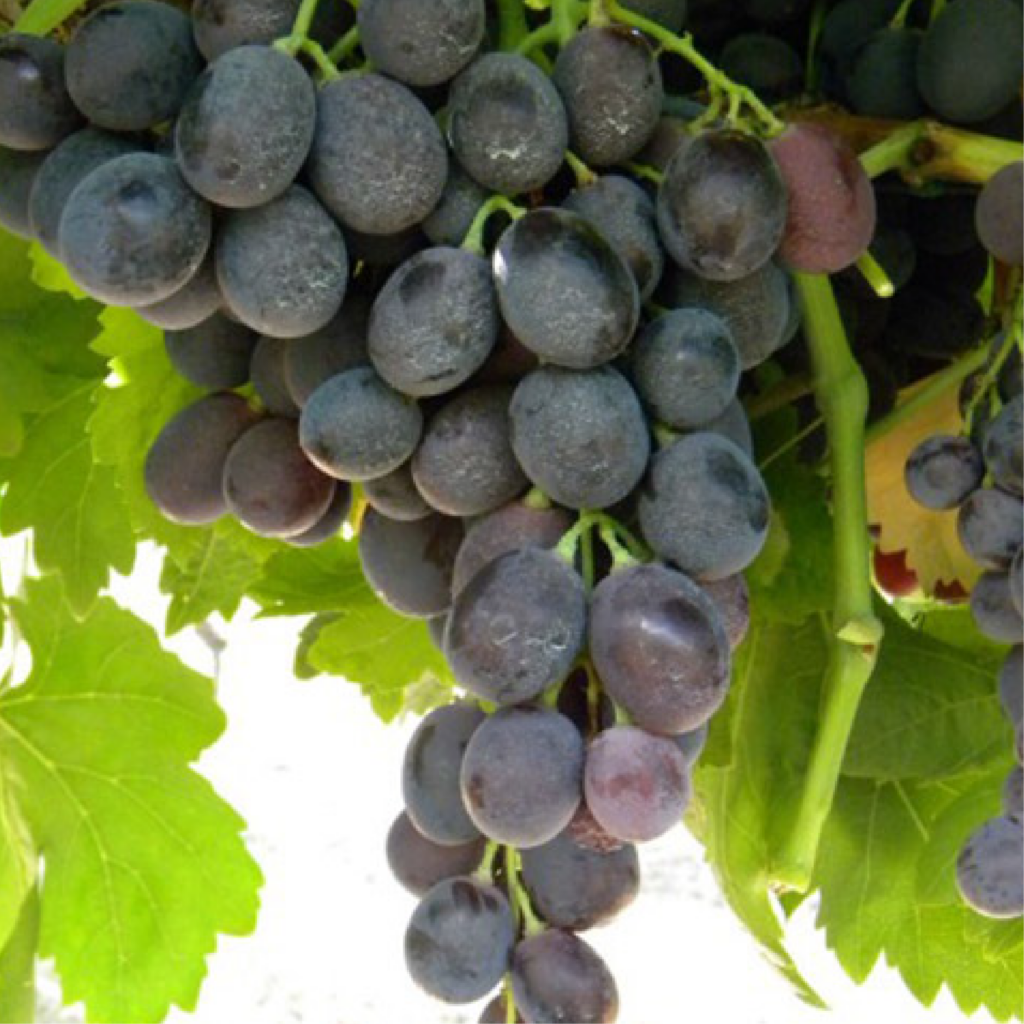
The cluster is exceptionally large, massive, cylindrical, and visually impressive, with an average weight of 600 to 800 g, while with excellent agricultural practice individual clusters can easily reach weights of over 1.2 kg. It is cylindrical-conical in shape, often with one noticeable lateral wing, moderately loose to semi-compact, giving it a beautiful and recognizable appearance in crates. The berry is very large to giant, with an average weight of 9–11 g and a length exceeding 28 mm, regular and uniform in its oval to slightly elongated shape. The skin is thick, firm, and completely smooth, and at full maturity it is intense dark blue to glossy coal-black in color, fully covered with a very dense and rich waxy bloom. The flesh is very firm, compact, fleshy, and recognizably crisp, typical of a firm-fleshed grape, and moderately juicy. The taste is outstanding, refreshing, harmoniously sweet, mild, neutral, and very pleasant, without pronounced acidity.
It is moderately resistant to fungal diseases. It is susceptible to downy mildew, Plasmopara viticola, and powdery mildew, Uncinula necator, so it requires standard and regular preventive chemical protection during the growing season. On the other hand, it tolerates rainy periods during autumn ripening very well and is highly resistant to gray mold, Botrytis, thanks to the thick and firm berry skin, which gives it a major advantage in humid autumns. It shows moderate resistance to low winter frosts, with winter buds successfully tolerating frosts down to -15°C, so it requires warmer, elevated, and well-sunlit vineyard sites.
The root system is exceptionally strong, deep, and branched. It uses moisture and nutrients from deeper soil layers very well, tolerating prolonged summer droughts and heat without difficulty, but it requires deep, permeable, warm, and moderately fertile soils, while it absolutely does not tolerate heavy, clayey, or waterlogged soils with a high groundwater level.
Our grafted grapevine plants are produced on highly compatible, certified rootstocks: Kober 5BB, Berlandieri x Riparia Kober 5BB, and its selected clones. This rootstock achieves a perfect and long-lasting anatomical graft union with Michele Palieri, ideally controls its great vigor, and provides outstanding adaptability to calcareous and skeletal soils with a high content of active lime.