
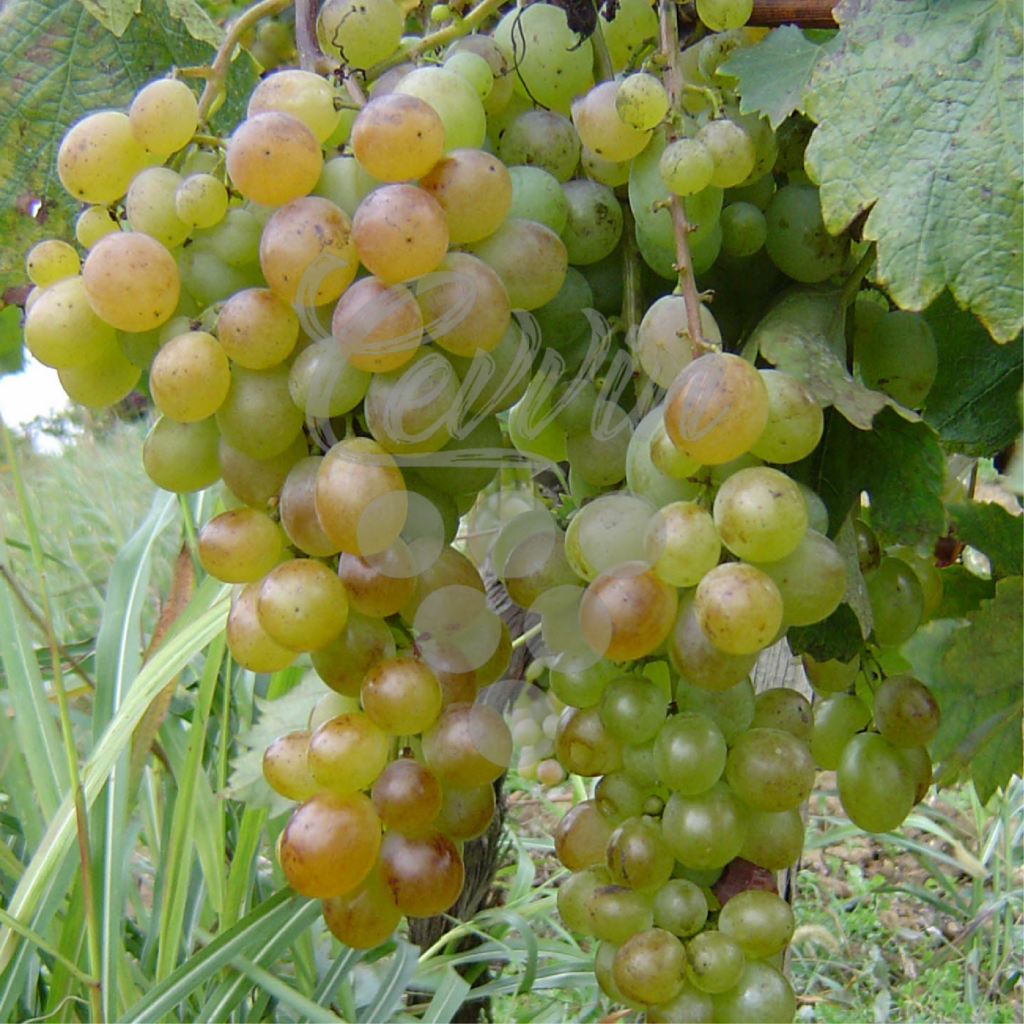
Afus Ali VCR 1
Afus Ali, clone VCR 1, is a premium, internationally certified clonal selection of the famous table grape variety Afus Ali, developed at the prestigious Italian institute Vivai Cooperativi Rauscedo, VCR. The Afus Ali variety itself is a very old and globally known oriental table grape variety, highly valued worldwide and registered under the synonyms Dattier de Beyrouth, Regina, or Bolgar. The elite clone VCR 1 was developed primarily to obtain significantly more uniform and larger clusters with a lower tendency toward berry shatter, placing it in the top position of white table grape varieties on the market.
It is a fully self-fertile variety. The flower is morphologically hermaphroditic, properly developed and bisexual. This ensures uniform and stable berry set within the cluster, without any need for other companion varieties in the vineyard. It flowers medium-early.
The vine is exceptionally vigorous, with very strong growth, thick and long shoots, and light green leaves, which is why it requires a high and stable training structure, including strong posts and multi-row wires. It performs excellently and gives maximum results exclusively on high training systems, such as pergolas, arbors, tendones, or cordon systems, where its vigor can fully express itself. It enters full bearing somewhat later after planting grafted vines, but once developed, it produces regular, stable, extremely abundant, and record-breaking yields. Mandatory long or mixed pruning is required, on canes with 10 to 12 buds, because the lower, basal buds on the shoot are naturally sterile or very weakly productive.
It belongs to the group of late to medium-late table grape varieties. In our region and under continental climatic conditions, it ripens during the second half of September and in early October.
Harvesting is carried out successively, or selectively, from mid-September through mid-October, selecting only the best sun-exposed and ripe clusters. One of the greatest advantages of this variety is that ripe fruit can remain on the vine for a very long time without dropping or spoiling, while the skin develops a beautiful amber color in the autumn sun, the sugar content rises sharply, and the proportion of harsh acids decreases.
It is characterized by premium post-harvest storage ability. In modern cold storage facilities and controlled conditions, it can be successfully kept for 2 to even 4 months while retaining full freshness, which makes it a leading variety for sale during late autumn and the winter holidays. Despite its delicate base, thanks to the firm and fleshy berry flesh, it tolerates handling, packing into crates, and long-distance transport exceptionally well, without any risk of berries detaching from the pedicel or being crushed.
The cluster is exceptionally large to giant, with an average weight of 400 to 600 g, while on the elite VCR 1 clone individual clusters can easily reach weights of over 1.5 kg. It is cylindrical-conical in shape, often with pronounced lateral wings, moderately loose to semi-compact, which prevents internal crushing of the berries. The berry is very large, long, and regular in its elongated-oval, cylindrical shape, resembling a date. The skin is thin, translucent, smooth, and delicate, initially yellow-green, turning attractive golden-yellow to amber on the sun-exposed side at full technological maturity, with a fine waxy bloom. The flesh is very firm, dense, crisp, typically fleshy, and moderately juicy. The taste is unsurpassed, refreshing, mild, and perfectly harmoniously sweet, with a refined, discreet, and elegant varietal aroma.
It is moderately resistant to fungal diseases. It is highly susceptible to downy mildew, Plasmopara viticola, and powdery mildew, Uncinula necator, while in humid and rainy autumns before harvest it requires intensive preventive protection against gray mold of the cluster, Botrytis cinerea. Its greatest biological drawback is its extremely high sensitivity to low winter temperatures and frosts, with winter buds suffering permanent damage already at temperatures of -13°C to -15°C. For this reason, vineyards must be established exclusively on warm, south-facing, sheltered, elevated, and well-sunlit vineyard sites.
The root system is exceptionally strong, deep, and powerful. It uses moisture from the deepest soil layers very well and tolerates prolonged summer droughts without difficulty, but it does not tolerate heavy, compacted, clayey, or overly wet soils with a high groundwater level, where the roots quickly suffer from rot.
Our grafted grapevine plants are produced on highly compatible, certified rootstocks: Kober 5BB, Berlandieri x Riparia Kober 5BB, and its selected clones. This rootstock ensures a perfect and long-lasting anatomical graft union with Afus Ali, ideally controls its great vigor, and provides outstanding adaptability to heavier, calcareous, and skeletal soils with a high content of active lime.