
Loch Ness
Loch Ness originates from Scotland, where it was developed at the renowned SCRI, the Scottish Crop Research Institute, by crossing complex blackberry hybrids. It was released into wide production in 1988. Due to its thornless canes, exceptional transportability, and record yields per unit area, it is the most popular, most widely grown, and economically most important commercial thornless blackberry variety both worldwide and in our region.
It is a fully self-fertile variety. It is characterized by an exceptionally high degree of self-pollination and abundant, long-lasting flowering on two-year-old canes, allowing it to produce maximum yields reliably and consistently in pure single-variety plantations without the need for other pollinator varieties. It flowers medium-early.
The plant is highly vigorous, robust, and long-lived. It forms a semi-upright bush that is completely thornless, which greatly facilitates and speeds up harvesting, care, and pruning. The canes are strong and upright at the base, while they bend in the upper part, which is why a strong support system is essential, such as a trellis with wires. It enters full bearing early and produces extremely high, record yields per bush and per hectare.
It belongs to the group of medium-early summer blackberry varieties. In our region and under continental growing conditions, it ripens during July and August, usually beginning to ripen in the first half of July.
Harvesting takes place during July and August and has a distinctly extended fruiting period lasting from 4 to even 6 weeks, which is why the fruit is harvested successively, every 2–3 days. The berries separate easily and cleanly from the calyx without crushing.
It has outstanding storage ability for soft fruit. In cold storage, it can be successfully kept for 5 to even 10 days. Due to its exceptionally firm and compact flesh, it tolerates picking, handling, packing, and long-distance transport perfectly, without losing its shine or leaking juice, and without turning red after harvest. It is the absolute favorite for fresh export to demanding European markets, and it is also widely used for deep freezing, including premium whole-fruit freezing, as well as for processing into premium juices, jams, and wine.
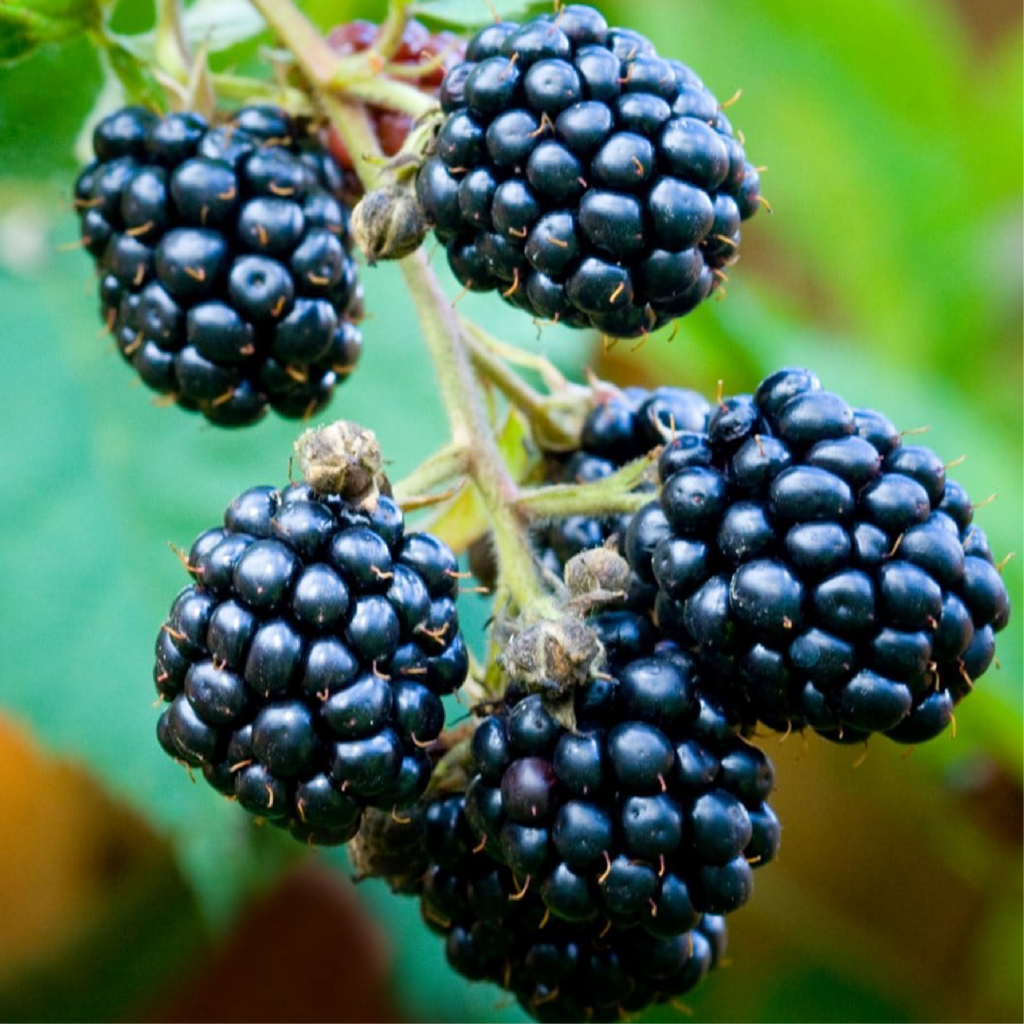
The fruit is medium-sized to large, with an average weight of 5–6.5 g, exceptionally uniform throughout the entire harvest season, and attractive, with an elongated-cylindrical shape. The skin is firm, smooth, very glossy, and intense black in color. The flesh is compact, fleshy, firm, and very juicy. The taste is outstanding, rich, full, and balanced between sweetness and moderate acidity, with a pronounced wild blackberry aroma that improves further when the fruit fully ripens on the plant.
It is characterized by very good overall resistance to diseases and pests. It shows high resistance to cane diseases, such as Didymella, and moderate resistance to leaf rust. It has exceptionally high resistance to low winter temperatures and frosts. In extremely wet and rainy years before harvest, standard preventive protection against gray mold of the fruit, Botrytis, is required.
The root system is moderately deep, strong, and well branched. It requires fertile, light, permeable, and well-drained soils, with mandatory installation of a drip irrigation system during the summer months in order to maintain fruit size in the later harvest waves. It naturally forms strong replacement canes from the root, but does not spread uncontrollably.
Our blackberry fruit plants are produced exclusively by vegetative propagation from controlled and healthy mother plantations, by rooting cane tips. They are therefore supplied as own-rooted plants, which guarantees complete varietal purity and premium plant health status.