
Titania
Titania is the best-known, most sought-after, and economically most important commercial blackcurrant variety, Ribes nigrum, in the world. It was developed in Sweden at the prestigious Svalöf research institute by crossing Altajskaja and Consort, and was released into wide production in 1980. Due to its record-high and stable productivity, uniform ripening of berries within the cluster, and outstanding genetic resistance to diseases, it is by far the leading and most widely planted industrial blackcurrant variety throughout Europe and in our region.
It is a fully self-fertile variety. It is characterized by an exceptionally high level of self-pollination and abundant flowering, so it reliably, regularly, and maximally bears in pure single-variety orchards without the presence of other varieties in the planting. It is an exceptional universal pollinator for all other blackcurrant varieties. It flowers medium-early to medium-late, and the flowers are very attractive to bees and show high resistance to late spring frosts.
The shrub is highly vigorous, strong, and robust, with an upright and compact growth habit in the first two years, later spreading nicely under the weight of an abundant crop and reaching a height of 1.2 to 1.5 meters. It enters the fruiting stage very early, as early as the second year after planting. It produces regular, stable, extremely high, and record-breaking yields. It forms long, compact, and richly filled clusters that are evenly and densely distributed throughout the entire shrub.
It belongs to the group of medium-early blackcurrant varieties. In our region and under continental climatic conditions, it ripens in mid- to late June, usually at the same time as the standard summer raspberry variety Willamette.
Harvesting takes place in the second half of June and in early July. Due to its exceptional and rare trait that all berries within the same cluster ripen simultaneously, as well as the firmness and elasticity of the berries themselves, it is the world’s leading variety fully adapted to mechanized harvesting with dedicated berry harvesters and shakers, during which the berries do not crack, crush, or leak juice.
In fresh condition, it can be successfully kept in cold storage for 7–14 days. Due to its exceptionally high content of dry matter, acids, anthocyanins, and record concentration of vitamin C, it is an unrivaled premium variety for industrial processing. It is widely used as first-class raw material for producing premium direct juices, syrups, jams, jam concentrates, marmalades, liqueurs, fruit yogurts, as well as for large-scale deep freezing as whole-fruit “rolend” quality.
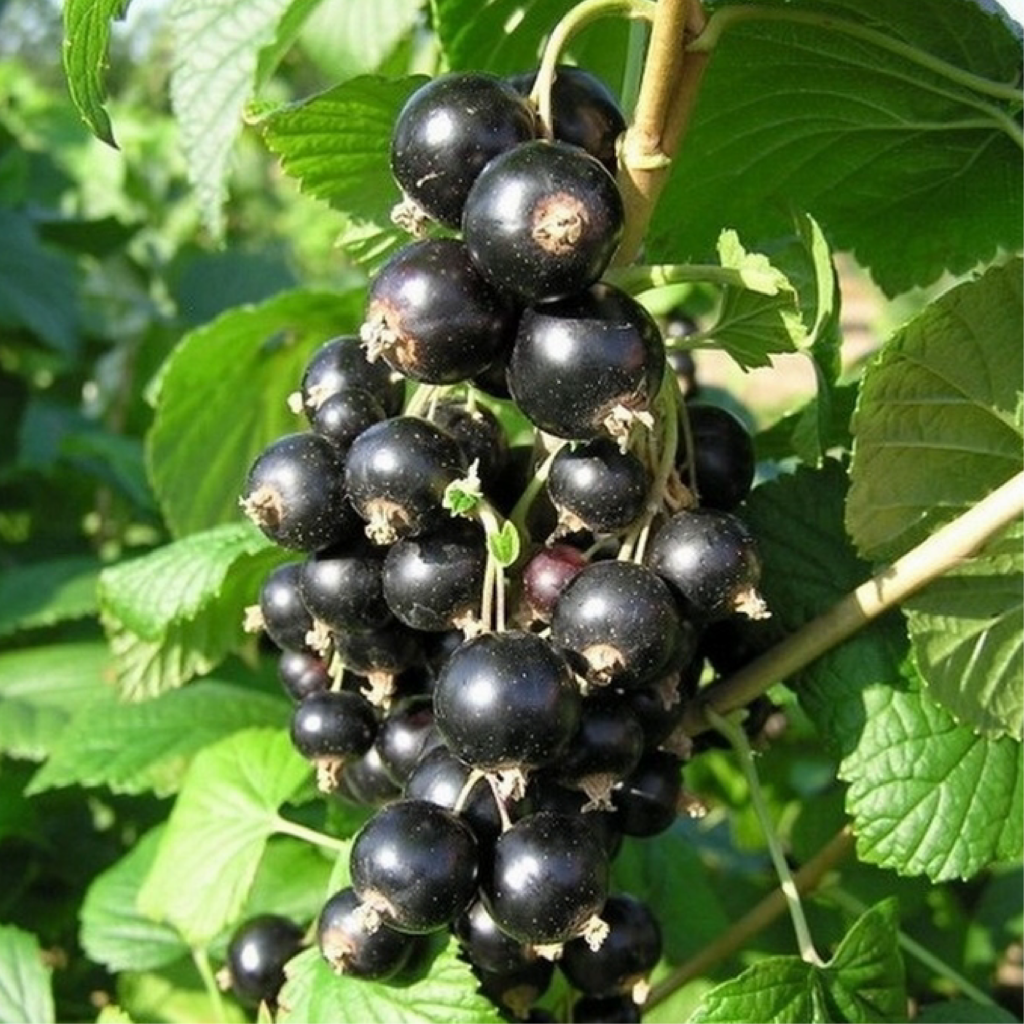
The berry is large for blackcurrant, with an average weight of around 1.0–1.3 g, exceptionally uniform within the cluster, and regular in its round shape. The skin is firm, elastic, smooth, and distinctly glossy, with an intense coal-black color. The flesh is dark purple, firm, compact, fleshy, and very juicy. The taste is refreshing and acidic, with moderate sugar content and a very strong, intense, noble, and recognizable blackcurrant aroma. Ripe berries separate easily, cleanly, and dry from the stem without crushing the skin.
It is characterized by exceptionally high genetic resistance to American powdery mildew, Sphaerotheca mors-uvae, and currant rust, making it an absolutely ideal variety for fully organic and ecological production in home gardens and commercial plantations without the use of aggressive chemical protection. It also has outstanding resistance of the wood and buds to extremely low winter frosts, tolerating temperatures down to -30°C during full dormancy without any damage.
The root system is surface-level, shallow, and distinctly fibrous, which makes blackcurrant extremely sensitive to summer drought and high temperatures. It requires fertile, humus-rich, moderately moist, lighter, and well-drained soils with a slightly acidic reaction, along with mandatory provision of regular irrigation, preferably a drip irrigation system, during the summer months so that berries in later ripening waves do not remain small and shriveled. On plots in lowland areas, the installation of shade nets is recommended in order to prevent leaf scorch during extremely hot days in July and August. The shrub renews and spreads naturally very well by forming new strong shoots from the basal part every year.
Our blackcurrant fruit plants are produced exclusively by vegetative propagation, by rooting mature cuttings under controlled conditions from healthy mother plantations, and are supplied as own-rooted plants. This guarantees complete varietal purity, virus-free quality, and long shrub life.