
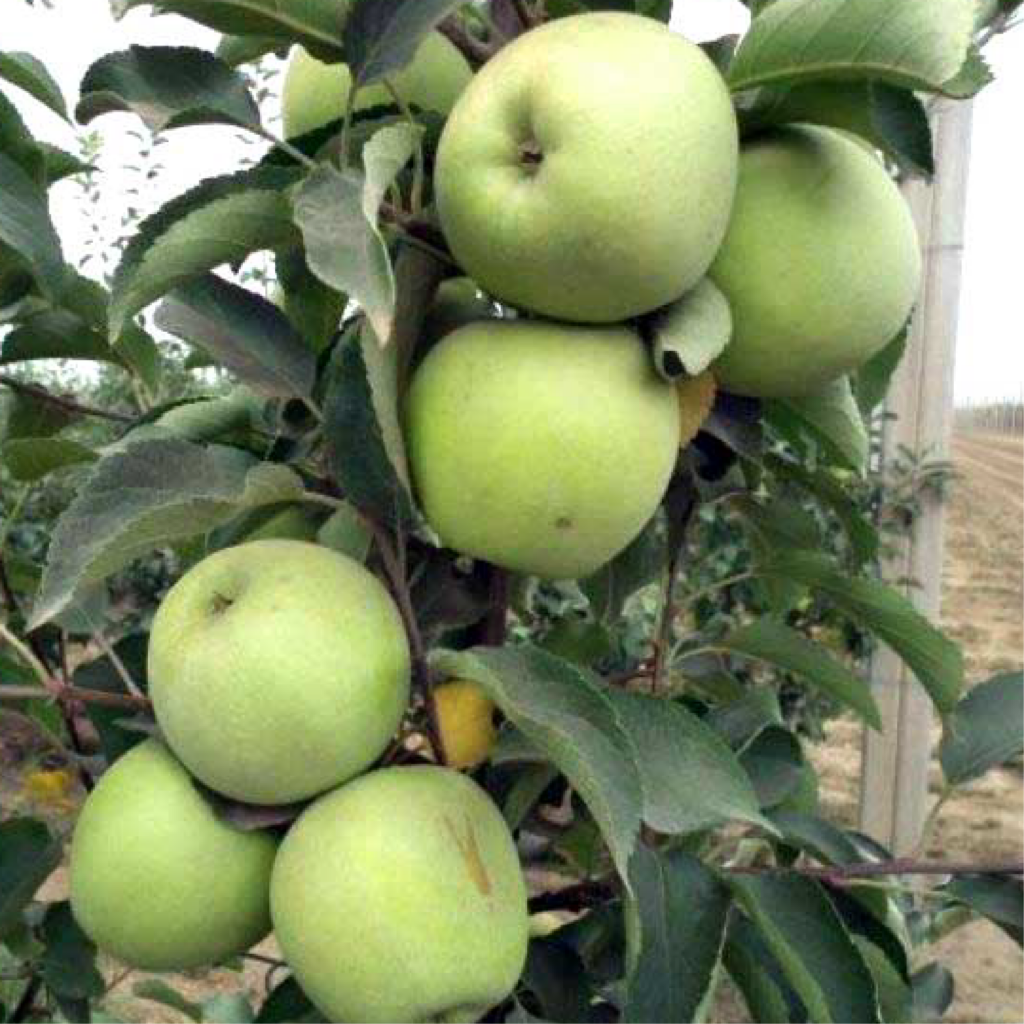
Mutsu
Mutsu, also known as Crispin, originates from Japan, where it was developed in 1930 at the Aomori Experimental Station by crossing Golden Delicious and Indo, and was officially registered in 1948. It was named after the former Japanese province of Mutsu. Due to its giant fruit size, unsurpassed juiciness, firmness, and distinctive refreshing taste, it is a traditionally highly valued winter apple variety, especially sought after in our continental regions.
It is a distinctly triploid variety with completely sterile pollen. It cannot pollinate itself, nor can it pollinate any other variety in the orchard. For this reason, orchards with Mutsu must include at least two different diploid pollinator varieties that flower at the same time, such as Granny Smith and Gala, or Idared and Golden Delicious, in order to ensure cross-pollination of all varieties on the plot. It flowers very late, which allows it to easily avoid late spring frosts.
The tree is extremely vigorous, with giant and robust growth, and powerful scaffold branches that form a wide, tall, and open canopy. It enters the fruiting stage early when grafted onto low-vigor rootstocks, in the second or third year after planting. Once it starts bearing, it produces regular, stable, and exceptionally high yields. It is prone to overcropping, which is why fruit thinning in early summer is essential in order to maintain uniform fruit size and prevent branch breakage.
It belongs to the group of late autumn to winter apple varieties. In our region and under continental climatic conditions, it reaches harvest maturity at the end of September and in early October.
Harvesting takes place at the end of September and in the first half of October. The fruit must be picked carefully because it is massive and heavy, at the stage when the skin changes from dark green to a uniform light green or pale yellowish color.
It has very good long-term storage ability. In modern ULO cold storage with controlled atmosphere, it successfully retains full freshness, juiciness, and firmness for 5–7 months, until spring. Due to its exceptionally firm and compact flesh, it tolerates picking, sorting, packing, and long-distance transport very well, without the risk of crushing. It is primarily a premium table variety, but due to its high juice content, it is also excellent for industrial processing.
The fruit is exceptionally large to giant, with an average weight of 230 to over 350 g, while individual fruit often reach over half a kilogram. It is uniform and regularly roundish-conical to slightly elongated in shape. The skin is firm and smooth, with a yellow-green ground color that at full maturity turns into a beautiful straw-yellow to delicate golden color, with visible whitish lenticels, or small dots. The flesh is pale yellowish to greenish-white, exceptionally firm, compact, crisp, and very juicy. The taste is premium, refreshing, sweet, with fine, refined, and pleasant acidity and a rich, recognizable aroma.
It is a moderately resistant variety. It shows outstanding resistance of the wood to harsh winter frosts. It has good natural resistance to powdery mildew. On the other hand, it is highly susceptible to apple scab on leaves and fruit, Venturia inaequalis, and to fire blight, Erwinia amylovora. Its greatest field drawback is its extreme susceptibility to black fruit spot, caused by Pseudomonas bacteriosis, which creates scab-like marks on the skin, as well as a tendency toward skin shriveling during storage if cold storage humidity is not ideal. This requires regular and intensive preventive protection.
Our apple fruit trees are produced on highly compatible and certified rootstocks: M9, M9 T337, the absolute and essential global standard for controlling the giant natural vigor of this variety in intensive orchards with a support system, M26, for medium-density orchards on lighter soils, and MM106, exclusively for home gardens and extensive orchards on poorer soils.