
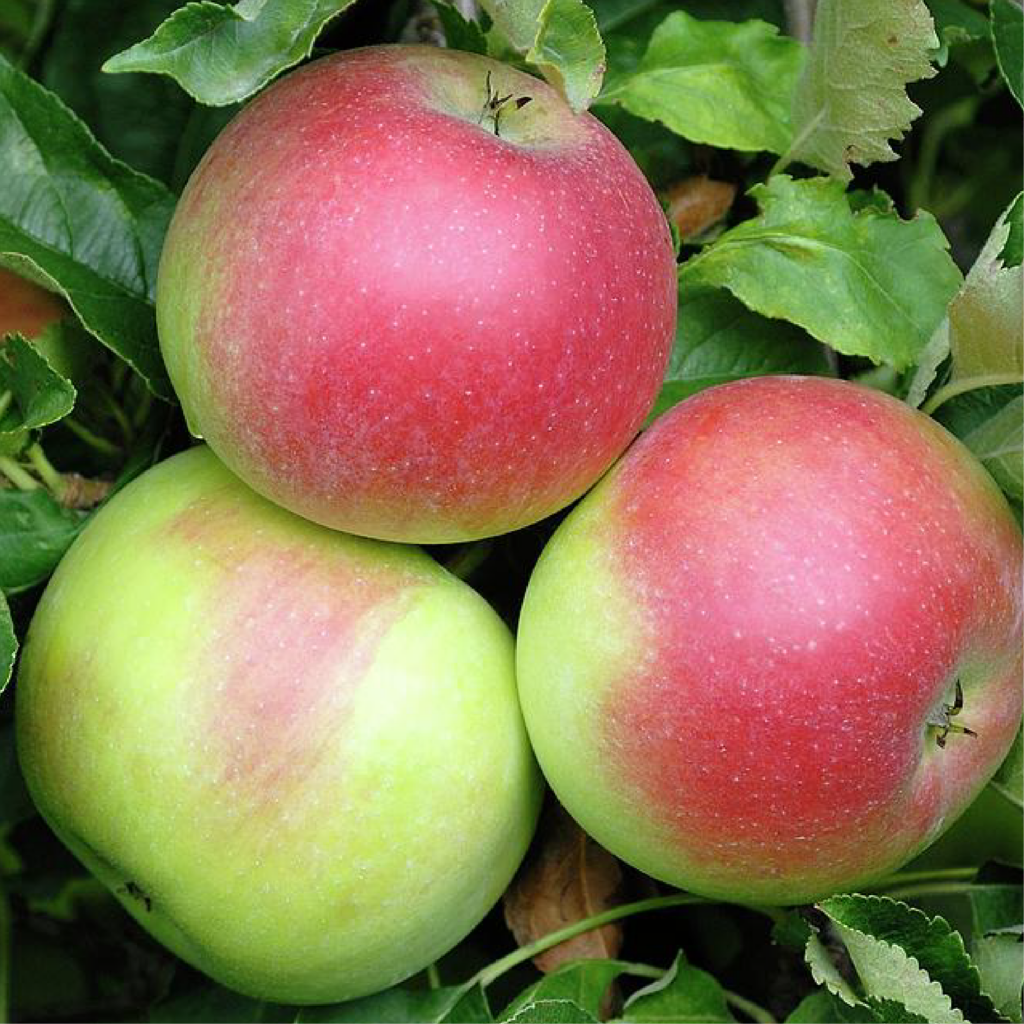
Idared
Idared originates from the USA, where it was developed in 1935. at the Experiment Station in the state of Idaho by crossing Jonathan and Wagener, and was released into production in 1942. Due to its unsurpassed vitality, record productivity, exceptional firmness, and ability to store for a long time even under the simplest conditions, it has for decades been the most widely grown, most widespread, and economically most important apple variety throughout the Balkans. With the status of a traditionally established variety, it forms the foundation of domestic apple production.
It is a fully cross-pollinated, self-sterile variety. It cannot set fruit with its own pollen, so the presence of compatible pollinator varieties in the orchard is essential. Since it flowers very early in spring, its best and field-proven pollinators are Golden Delicious, Granny Smith, Gala, Fuji, and Chadel. Idared itself produces exceptionally abundant and high-quality pollen, making it an excellent pollinator for almost all other diploid and triploid apple varieties.
The tree is low to moderately vigorous, with a wide, rounded, moderately dense canopy and thin, elastic branches that bend in arches toward the ground under the weight of the crop. It enters the fruiting stage extremely early, often setting its first fruit as early as the second year after planting. Once it starts bearing, it produces regular, stable, extremely abundant, and record-breaking yields. It responds very well to standard pruning and requires chemical or hand thinning of the fruit in years of excessive cropping in order to avoid fruit size reduction.
It belongs to the group of late autumn apple varieties. In our region and under continental climatic conditions, it reaches harvest maturity at the end of September and in early October.
Harvesting takes place at the end of September and during the first half of October, at the stage when the fruit develops its characteristic color while the flesh retains maximum firmness. The fruit is very easy and clean to pick and does not drop from the tree on its own, even in stronger winds.
It has absolutely unsurpassed long-term storage ability. In standard cold storage facilities and well-ventilated storage rooms without controlled atmosphere, it successfully retains full freshness, juiciness, and firmness for 6 to even 8 months, until May of the following year, without the risk of internal flesh browning or skin greasiness. Due to its exceptionally firm flesh and firm skin, it tolerates picking, rough mechanical sizing, packing, and long-distance transport perfectly, without the risk of crushing. It is primarily the leading table variety for mass fresh consumption, but it is also widely used in the industry for the production of juices, purées, and marmalades.
The fruit is large to very large, with an average weight of 180–230 g or more, uniform, and regular round to slightly flattened-round in shape. The skin is medium-thick, smooth, glossy, and firm, with a pale yellow-green ground color covered over more than 70–80% of the fruit surface by an intense, attractive light red blush and stripes on the sun-exposed side. The flesh is whitish to light yellow, very firm, compact, juicy, and slightly crisp. The taste is refreshing, distinctly acidic to sweet-acidic, with a moderate, fine, and pleasant varietal aroma. During long storage, the acidity gradually decreases, while the fruit gains sweetness and harmony of flavor.
It is a moderately resistant variety. It shows excellent resistance of the wood to extremely low winter temperatures, tolerating temperatures down to -25°C. It has good natural resistance to fire blight, Erwinia amylovora. On the other hand, due to its very early start of vegetation, its flower buds are highly sensitive to late spring frosts. It is also highly susceptible to powdery mildew, Podosphaera leucotricha, and susceptible to apple scab on leaves and fruit, Venturia inaequalis, which requires mandatory, professional, and intensive preventive chemical protection from the very beginning of spring budbreak.
Our apple fruit trees are produced on highly compatible and certified rootstocks: M9, M9 T337, the Dutch standard for intensive high-density orchards with a support system, M26, which is excellent for this variety because it provides optimal growth strength, and MM106, for home gardens and lighter, poorer soils, with which this variety achieves a perfect and long-lasting graft union.