
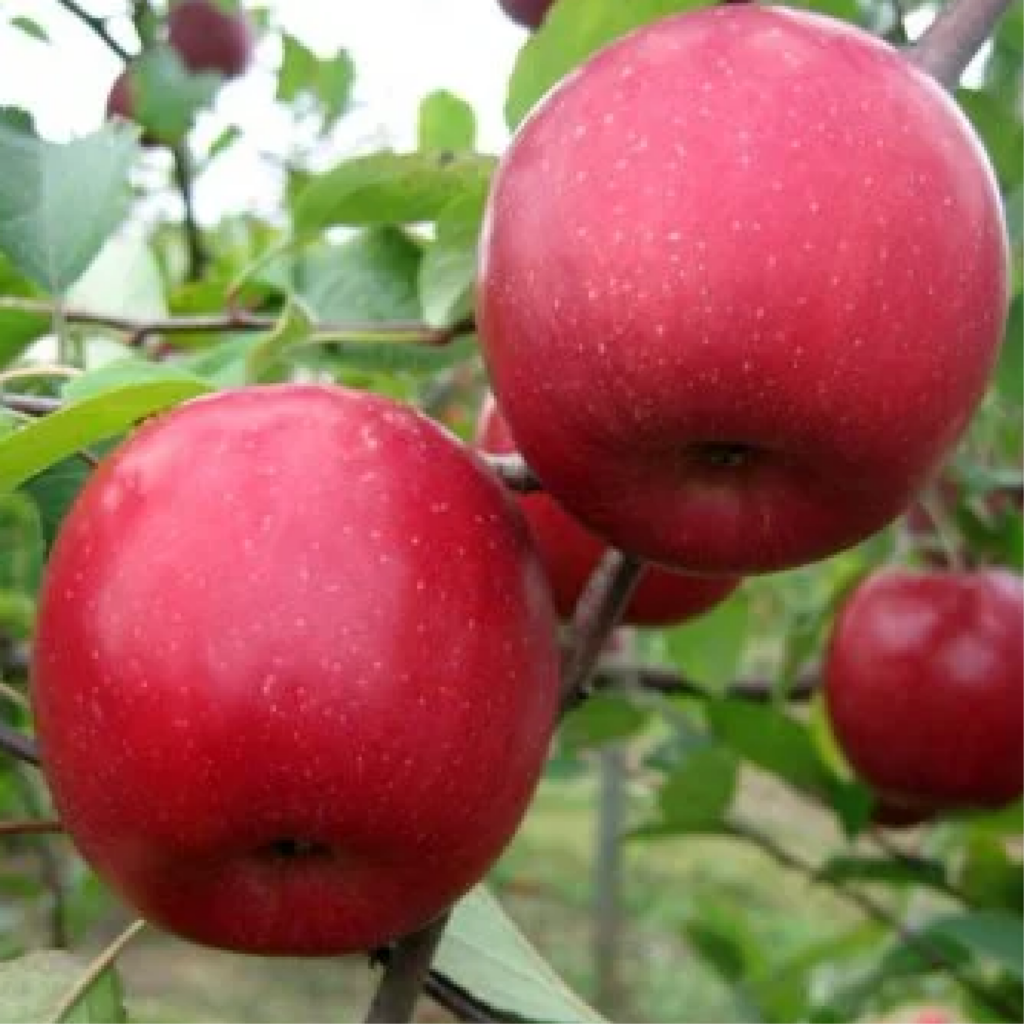
Braeburn NAKB
Braeburn, clone Mariri Red / NAKB, is a premium, internationally certified clonal selection of the famous New Zealand variety Braeburn, purified and standardized by the official Dutch authority NAKB. The original variety was discovered in 1952 in New Zealand as a chance seedling, presumed to have originated from Lady Hamilton and Granny Smith. The Mariri Red clone was selected primarily to achieve significantly more intense, uniform, and earlier red-orange skin coloration, which greatly increases its commercial value and visual appeal in crates on the European market.
Partially self-fertile, but pollinators recommended/mandatory for commercial crop. The best and field-proven pollinators for this variety are Granny Smith, Golden Delicious, Gala, and Fuji. It flowers medium-late, abundantly, and over a long period.
The tree is naturally low-vigor, with a compact, moderately wide canopy and thin branches that bend in arches under the weight of the crop. It enters the fruiting stage extremely early, often setting and producing its first fruit as early as the second year after planting. Due to its low-vigor genetics and tendency toward overcropping, it produces abundant, stable, and record yields, but requires mandatory, strong, and early fruit thinning, as well as increased nitrogen fertilization, in order to prevent premature tree aging and the onset of alternate bearing.
It belongs to the group of late autumn apple varieties. In our region and under continental climatic conditions, it ripens late, during the first half of October, usually between October 5 and 15.
Harvesting takes place in the first half of October, in several selective passes, because the fruit inside the canopy develops color more slowly. Timely harvesting is crucial for successful long-term storage.
It has exceptionally good storage ability. In modern ULO cold storage with controlled atmosphere, it successfully retains full freshness, high juiciness, and crispness for 6–8 months. Due to its exceptionally firm flesh and firm skin, it tolerates picking, mechanical sizing, packing, and long-distance transport perfectly, without the risk of crushing or loss of freshness. It is primarily a premium table variety.
The fruit is medium-sized to large, with an average weight of 170–210 g, uniform, and regularly roundish-conical to slightly elongated in shape. The skin is firm, smooth, and glossy, with a yellow-green ground color covered over more than 60–75% of the fruit surface by an attractive bright red blush and orange stripes on the sun-exposed side. The flesh is creamy-white, exceptionally firm, compact, fleshy, distinctly crisp, and very juicy. The taste is outstanding, rich, and refreshing, characterized by a perfect, high balance of sugars and acids, with a pronounced, refined, and recognizable aroma.
It is a moderately resistant variety. It shows good resistance of the wood to winter frosts. It is susceptible to apple scab on leaves and fruit, Venturia inaequalis, and to fire blight, Erwinia amylovora. Its greatest drawback is its high susceptibility to bitter pit and internal flesh browning, known as Braeburn browning disorder, during storage, which is why regular and intensive foliar calcium treatments during the growing season are required, along with precise management of carbon dioxide levels in cold storage.
Our apple fruit trees are produced on highly compatible and certified rootstocks: M9, M9 T337, the Dutch standard for intensive high-density orchards with a support system, where the low vigor of both the rootstock and the variety requires premium orchard management, M26, which is excellent for this variety as it provides optimal strength, and MM106, for home gardens and lighter soils.