
Regina
Regina originates from Germany, where it was developed at the renowned Jork research station near Hamburg through planned crossing of Rube and Schneider’s Späte Knorpelkirsche, and was released into wide commercial production in the 1990s. Due to its extremely late flowering and ripening, premium fruit size, exceptional flesh firmness, and unsurpassed, legendary resistance to cracking caused by rain, it is currently the most highly valued, most sought-after, and economically most profitable late table sweet cherry variety in the world, successfully closing the harvest season.
It is a fully cross-pollinated variety. It belongs to the II sterility group and cannot set fruit with its own pollen, so the presence of compatible pollinator varieties in the orchard is essential. It is genetically fully compatible with Kordia, but it cannot be successfully pollinated by it in the field because their flowering times do not overlap at all, as Kordia flowers much earlier. Since Regina flowers extremely late, it requires specific late-flowering pollinators, and its best, biologically synchronized, and field-proven partners are Karina, Sylvia, Cherokee, and Penny.
The tree is naturally vigorous to very vigorous, with strong and robust growth, an attractive, spacious, broad-pyramidal canopy, and excellent branch angles that spread naturally and evenly. It enters full bearing later when grafted onto classic vigorous rootstocks, around the fourth or fifth year, which is why it gives outstanding results on modern medium-vigor rootstocks. Once it starts bearing, with suitable late-flowering pollinators, it produces regular, stable, and very high yields every year. It requires standard pruning in order to maintain the optimal balance between growth, canopy light exposure, and fruit size.
It belongs to the group of very late sweet cherry varieties. In our region and under continental climatic conditions, it ripens last, at the end of June and in early July, usually between June 22 and July 5, in the seventh week of the sweet cherry season, arriving 5 to 7 days after Kordia.
Harvesting takes place at the end of June and in early July. The fruit ripens exceptionally uniformly and is characterized by a long, green, and firm stem, which greatly facilitates and speeds up hand picking. One of the greatest advantages of this variety is that ripe fruit can remain on the tree for up to two weeks after full maturity without losing any firmness, crispness, or quality, giving growers enormous flexibility and the possibility of waiting for the best market price.
It is characterized by premium and unsurpassed long-term storage ability. In fresh condition, it can be successfully kept in cold storage and controlled atmosphere storage for 2 to even 3 weeks while retaining full freshness. Due to its extremely firm, compact, and fleshy fruit, it tolerates picking, rough mechanical sizing, packing, and long-distance transport perfectly, without any risk of crushing or loss of gloss. It is the absolute premium leader and favorite for late global export. It is used exclusively for luxury fresh table consumption.
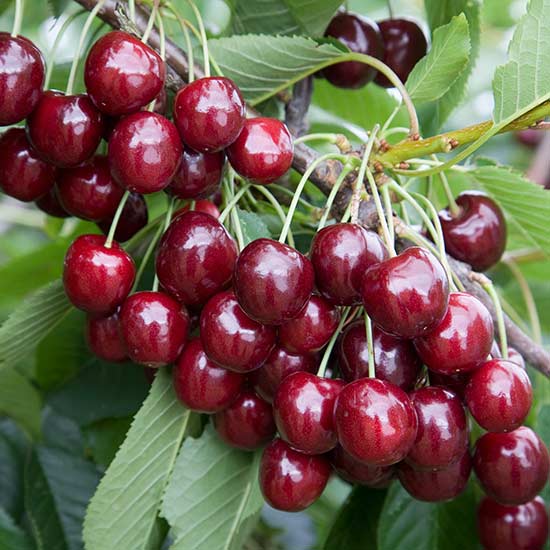
The fruit is exceptionally large to giant, with an average weight of 9.5 to over 11 g and a caliber diameter exceeding 28–32 mm. It is uniform on the tree and attractive in its large elongated-heart-shaped, oval form. The skin is thicker, firm, elastic, smooth, and distinctly glossy, intense dark red at harvest, turning beautiful dark burgundy to glossy coal-black at full maturity. The flesh is dark red, extremely firm, compact, and crisp, typical of a premium firm-fleshed sweet cherry, and moderately juicy. The taste is outstanding, rich, and dessert-like, characterized by high sugar content, fine refreshing acidity, and a rich varietal aroma. The stone is medium-sized.
It is characterized by exceptionally high genetic resistance of the fruit to cracking caused by heavy summer rains during the ripening period, placing it clearly in first position for reliable open-field cultivation without protective covers. In addition, thanks to its extremely late flowering, its flowers easily avoid late spring frosts and cold spells. It shows excellent resistance of the wood to low winter temperatures, as well as good resistance to Monilinia and leaf rust. It requires standard preventive chemical protection and protection from birds, which are attracted by the large, dark crop.
The root system is strong, deep, and branched. It tolerates dry periods very well in mature years, but requires deep, permeable, light, and fertile soils, while it absolutely does not tolerate heavy, clayey, compacted, or waterlogged soils with a high groundwater level, where lack of oxygen quickly leads to root decline.
Our sweet cherry fruit trees are produced on highly compatible, certified rootstocks: mahaleb cherry, Prunus mahaleb, and wild sweet cherry for classic and long-lived orchards. Since Regina naturally has poorer compatibility and a tendency toward premature aging and decline on Gisela 5 rootstock, in our nursery we produce it for intensive and high-density orchards exclusively on the modern vegetative rootstock Gisela 6, which ideally controls its natural vigor, ensures a perfect and long-lasting graft union, drastically accelerates entry into full bearing, as early as the second year, and guarantees stable, high, and uniform yields of premium-sized fruit.