
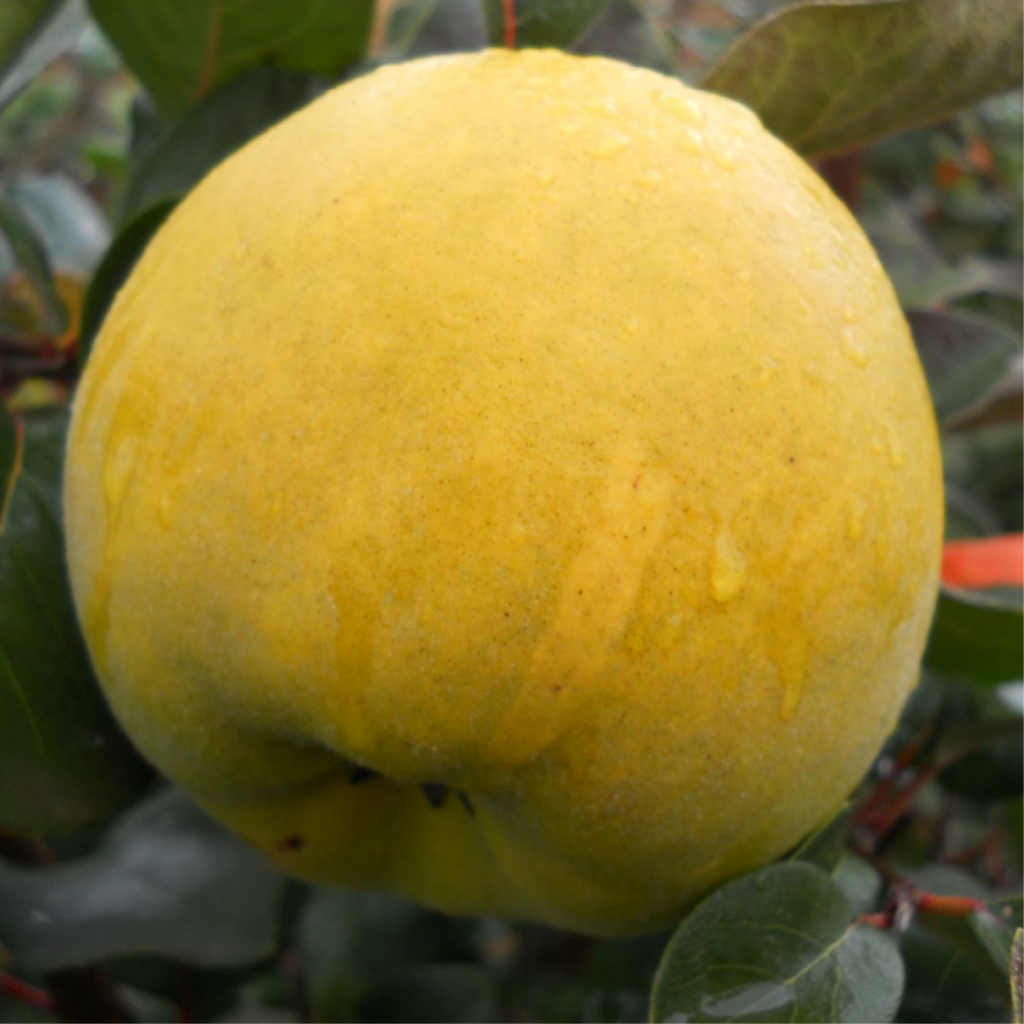
Leskovacka
Leskovačka quince is our autochthonous domestic variety, originating from the area around Leskovac, Serbia. Due to its premium fruit quality, record-high dry matter content, exceptional aroma, and high productivity, it is considered the best, most sought-after, and economically most important quince variety throughout the Balkans. It represents the absolute pomological standard in the class of apple-shaped quinces.
It is a partially, or incompletely, self-fertile variety. Although it can set a smaller part of the crop with its own pollen, stable, high, and regular yields require the presence of compatible pollinator varieties in the quince orchard. Its best natural partner and pollinator is Vranjska quince, also known as Dunjac, or the Champion variety. In commercial orchards, it is planted in the ideal ratio of 90% Leskovačka to 10% Vranjska, where these two varieties act as perfect mutual pollinators. It flowers medium-late to late, thereby successfully avoiding late spring frosts.
In the first years after planting, the tree is vigorous and strong-growing, while in full bearing it becomes moderate, or medium, in vigor. It forms a recognizable, rounded, wide, and very dense canopy with long branches that bend in arches under the weight of the crop. It enters the fruiting stage very early, often as early as the third year after planting. Once it starts bearing, it produces regular, abundant, and exceptionally stable yields. It responds very well to standard pruning aimed at improving ventilation inside the crown.
It belongs to the group of autumn fruit species. In our region and under continental climatic conditions, it reaches harvest maturity in the first half of October, usually between October 5 and 15.
Harvesting takes place during October, exclusively at the stage of technological maturity, when the fruit changes from pale greenish to intense lemon-yellow. The fruit must be picked carefully because it is heavy and prone to bruising when handled roughly.
It is characterized by exceptionally good storage ability. In standard, well-ventilated storage rooms and cold storage facilities, it can be successfully kept for 3 to even 5 months. During storage, the fruit loses its initial astringency, acidity slightly decreases, and the flesh develops its distinctive, extremely strong, noble, and pleasant aroma, which refreshes the room. It is the absolute number one variety, both domestically and worldwide, for industrial and home processing. It is used to produce premium quince brandy of outstanding quality, as well as high-quality jams, marmalades, compotes, preserves, and quince cheese, known as kitnikez.
The fruit is large to very large, with an average weight of 250–350 g, and in good conditions even over 400 g. It is uniform and regular, with a highly attractive apple-shaped, rounded form and a moderately ribbed surface around the calyx end of the fruit. The skin is thin, smooth, firm, and glossy, with an intense lemon-yellow color, and at harvest it is partly covered with fine gray down, or fuzz, which is easily removed during ripening and by wiping. The flesh is pale yellow, firm, compact, and moderately juicy, with naturally pronounced stone cells, or sclereids, around the seed cavity, giving it a brittle structure. The taste is refreshing, acidic-sweet-astringent, with a specific and luxurious aroma.
It belongs to the group of fruit species more sensitive to diseases. It is highly susceptible to fire blight, Erwinia amylovora, and Monilinia blossom and fruit rot, Monilinia laxa, which in humid and warm springs requires mandatory, professional, and maximally regular preventive chemical protection, using copper-based products during dormancy and targeted fungicides during flowering. Under poor storage conditions with excess humidity, it may be susceptible to fruit rot. It shows excellent resistance of the wood to winter frosts.
Our quince fruit trees are produced on highly compatible and certified rootstocks: Quince M-A and Quince BA-29, with which this variety achieves excellent compatibility, a perfect and long-lasting graft union, early entry into bearing, and ideal control of tree vigor.