
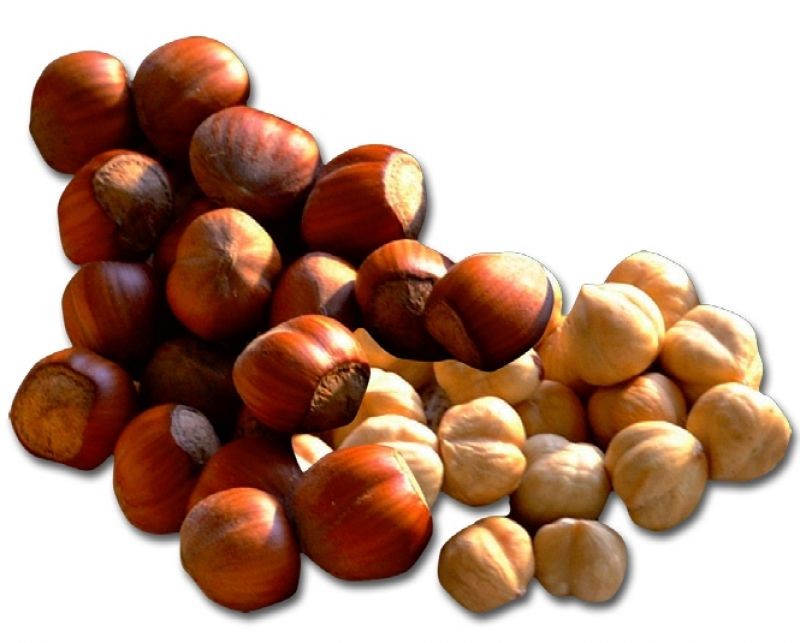
Tonda Gentile Romana
Tonda Gentile Romana is a premium and globally valued Italian hazelnut variety originating from central Italy, specifically the Lazio region, province of Viterbo. Due to its unsurpassed technological characteristics and premium kernel quality, it is protected in the European Union by the prestigious Protected Designation of Origin, or PDO, status. Alongside Tonda Gentile delle Langhe, it represents the very top of the world assortment and is one of the most sought-after varieties in the confectionery industry for the production of premium brands.
It is a fully cross-pollinated variety with pronounced protogyny. It cannot set fruit with its own pollen, so the presence of compatible pollinator varieties in the orchard is essential. Since it flowers medium-late to late, with female flowers opening significantly before the male catkins, it requires partners with a synchronized flowering period. It is distinctly incompatible with the Cosford variety, as they share the same sterility alleles and cannot pollinate each other. The best, biologically synchronized, and field-proven pollinators for this variety are Nocchione, Tonda di Giffoni, and Mortarella.
It grows as a moderately vigorous to vigorous shrub with an upright to semi-upright habit, naturally forming a moderate number of basal root shoots, which makes maintenance considerably easier. When grafted, it develops as an exceptionally stable, long-lived, and well-formed tree with a moderately dense canopy. It enters the fruiting stage very early, as early as the third year after planting. Once it starts bearing, it produces regular, stable, abundant, and very reliable yields every year. It responds very well to standard pruning aimed at improving ventilation and light penetration inside the canopy.
It belongs to the group of medium-early hazelnut varieties. In our region and under continental climatic conditions, it ripens at the end of August and in early September.
Harvesting takes place at the end of summer. An exceptional pomological and economic advantage of this variety is its very short, open husk, or involucre, from which mature nuts fall out completely and naturally directly to the ground at full autumn maturity. This botanical trait dramatically reduces costs, speeds up, and facilitates mechanical nut collection from the ground using vacuum harvesters, without the need for subsequent husking.
In a dry, cool, and well-ventilated space, well-dried in-shell nuts can be stored successfully for 6 to even 12 months without any loss of quality. Thanks to the firm shell, the kernel retains its ideal texture, aroma, and moisture content for considerably longer than when previously shelled.
The nut is small to medium-sized, with an average weight of around 2.4–2.6 g, exceptionally uniform on the tree, and regular in shape, roundish-spherical, typical of the “tonda” type. The shell is thin to medium-thick, smooth, chestnut to light brown in color, with delicate longitudinal stripes. The kernel is small to medium-sized, with an average weight of 1.1–1.3 g, light cream in color, firm and crisp in texture, exceptionally sweet, and luxuriously aromatic. It is characterized by a high kernel ratio of around 45–48%. It is an absolute favorite in both the global and domestic confectionery industry because, after roasting, or blanching, the thin kernel pellicle separates easily and almost completely, over 95%, leaving a perfectly clean, round kernel ideal for producing premium chocolates, premium spreads, and hazelnut pastes.
It is a moderately resistant variety. It shows outstanding natural resistance of the wood to low winter temperatures, as well as high genetic resistance to hazelnut bud mite, Phytoptus avellanae, which gives it a major cultivation advantage in the field. In humid and rainy years, it requires standard preventive protection against fungal diseases, including Monilinia fruit rot, while among pests the greatest threat is the hazelnut weevil, Balaninus nucum, which requires timely chemical protection.
The root system is surface-level and distinctly fibrous when grown from its own shoot, as a shrub, so it requires sufficient soil moisture. When grafted onto Turkish hazel rootstock, however, it develops an exceptionally deep, powerful taproot that tolerates prolonged summer droughts extremely well, provides high tree stability, and completely prevents the appearance of root suckers.
Our hazelnut plants are produced in two premium forms: as trained one- or two-year-old own-rooted shoots for bush-form cultivation, or as highly sought-after grafted hazelnuts on Turkish hazel rootstock, Corylus colurna, for tree-form cultivation, which guarantees the absence of basal shoots, easier inter-row cultivation, and exceptional orchard longevity.