
Muscat Hamburg 202
Muscat Hamburg, clone INRA-ENTAV 202, is a premium, internationally certified clonal selection of the famous English variety Muscat Hamburg, developed and officially selected in France by the state institute INRA. The elite clone 202 was created primarily to obtain significantly larger clusters with more pronounced and more uniform dark blue skin coloration and an exceptionally high sugar level, while guaranteeing healthy, virus-free, certified planting material. Today, throughout Europe, it represents the irreplaceable gold standard for establishing professional vineyards of this world-famous, universal variety.
It is a fully self-fertile variety. The flower is morphologically hermaphroditic, properly developed and bisexual, with high pollen germination. It is important to emphasize that despite clonal selection, clone 202 retains the variety’s natural and inherited tendency toward flower shatter, or coulure, and the appearance of small, green, pea-sized berries if cold, rainy, and unfavorable spring conditions occur during flowering. Because of this trait, during the flowering stage the variety requires appropriate agricultural measures, including pinching the tips of fruiting shoots and applying boron. It flowers medium-early.
The vine is vigorous, with strong vegetative growth and thick, strong, and moderately elastic shoots. It requires the mandatory installation of a strong, high, and stable training structure, such as a trellis with multiple wire levels. It gives outstanding and stable results primarily on elevated and high training systems such as pergolas, arbors, cordons, or tendones, where its vegetative strength can be more easily distributed. It enters full bearing early after planting grafted grapevines and produces regular and exceptionally abundant yields per vine. It requires long pruning, leaving canes with 10 to 12 buds, because the lowest, basal buds on the shoot are naturally weakly productive.
It belongs to the group of medium-late grapevine varieties. In our region and under continental climatic conditions, it ripens during September, most often in the first half to mid-September, depending on the sun exposure of the plot. One of the greatest ampelographic advantages of this variety is that the clusters can remain on the vine for a very long time after full technological maturity without dropping; during this autumn hang time, the fruit accumulates an exceptionally high sugar content, often exceeding 22–24%, while the recognizable, fine Muscat aroma becomes even more pronounced.
Its fresh-storage ability is moderately short, and the variety is naturally sensitive during transport. Since it has thin skin, long and thin berry pedicels, and exceptionally juicy berries, it requires great care during picking and tolerates long, rough transport to distant markets less well, as it is prone to berry shatter, or berries detaching easily from the cluster, under stronger pressure. It is packed exclusively by hand in shallow crates in a single layer.
It is characterized by an exceptional and unique dual, or combined, purpose. In addition to being a premium, luxury table grape for fresh consumption that is always in high demand on the market, clone 202 is also highly valued and sought-after in oenology for producing premium, very aromatic Muscat rosé and lighter red wines, as well as for distilling first-class, highly aromatic grape brandy with a luxurious bouquet.
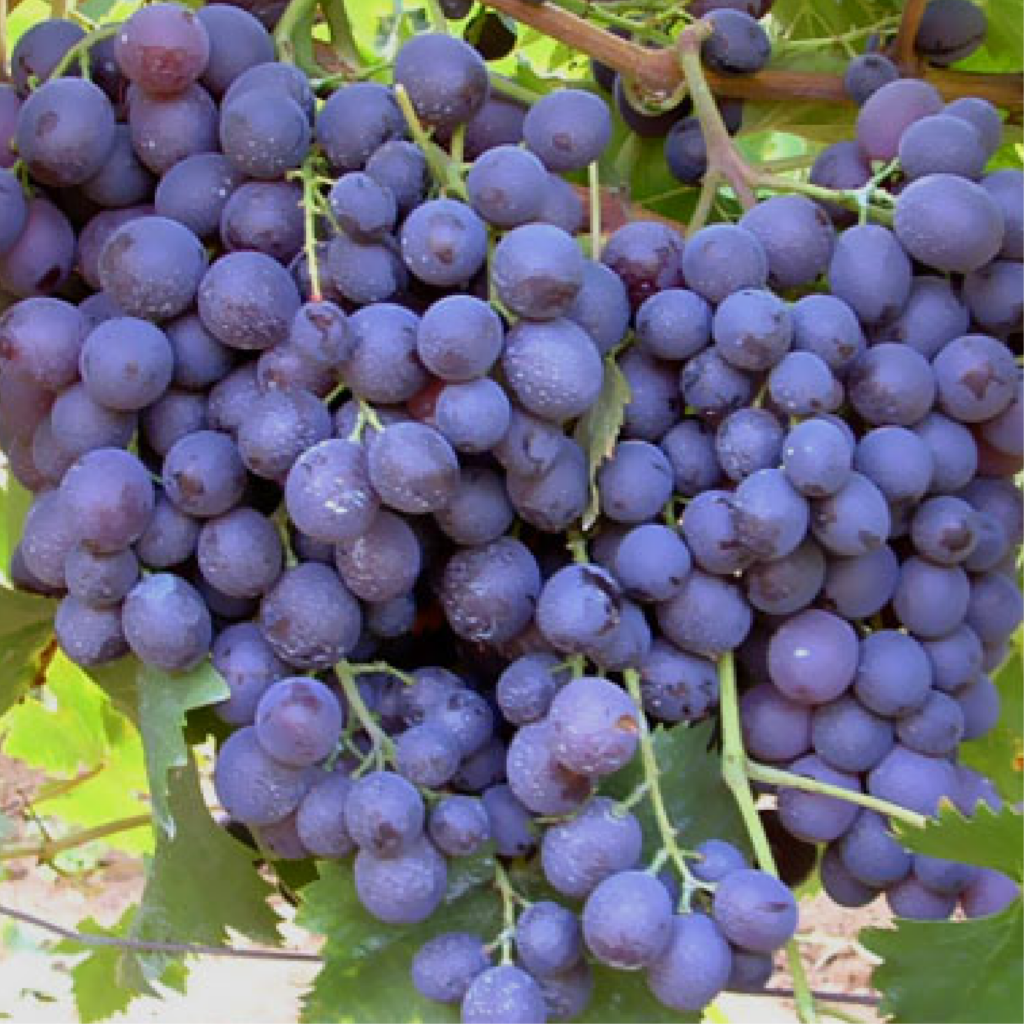
The cluster is large, uniform, and exceptionally elegant, with an average weight of 400 to 600 g. It is cylindrical-conical in shape, with one or two noticeable lateral wings, well distributed on the shoot, and naturally ideally loose, allowing air and sunlight to pass through the interior. The berry is large and regular in its ovate-oval shape. The skin is thin and smooth, and on the elite clone 202, at full maturity, it develops an exceptionally uniform, attractive dark blue to deep coal-black color, without red or uncolored berries, covered with a rich waxy bloom. The flesh is moderately firm, compact, exceptionally juicy, and completely melting in the mouth. The taste is unsurpassed, rich, and refreshing, characterized by a very strong, persistent, and recognizable Muscat aroma, with fine notes of rose and nutmeg, and high sweetness.
It belongs to the group of varieties more sensitive to diseases and climatic factors. It is moderately susceptible to powdery mildew, Uncinula necator, and downy mildew, Plasmopara viticola, while in extremely humid and rainy autumns before harvest it is highly susceptible to gray mold of the cluster, Botrytis cinerea, due to the thin and delicate berry skin, which requires regular and timely preventive chemical protection. Its greatest biological drawback is very poor resistance to low winter frosts, with winter buds suffering widespread frost damage already at temperatures of -15°C. Vineyards must therefore be established exclusively on warm, south-facing, well-ventilated vineyard sites sheltered from frost.
The root system is strong, deep, and branched. It uses moisture and nutrients from deeper soil layers very well and successfully tolerates moderate summer droughts, while giving the best results on light, permeable, warm, well-drained, and moderately fertile soils.
Our grafted grapevine plants are produced on highly compatible, certified rootstocks: Kober 5BB, Berlandieri x Riparia Kober 5BB, and its selected clones. This rootstock achieves a perfect and long-lasting anatomical graft union with Muscat Hamburg, ideally controls its vigor, and provides outstanding adaptability to calcareous, heavier, and skeletal soils with a high content of active lime.