
Nero
Nero is the best-known, most widely grown, and economically most important selected variety of black chokeberry, Aronia melanocarpa, developed in the Czech Republic. Due to its exceptionally high and stable yield, large fruit size, and outstanding content of antioxidants, polyphenols, vitamins, and minerals, it represents the standard in professional and commercial chokeberry cultivation.
It is a fully self-fertile variety. It is characterized by an exceptionally high percentage of self-pollination and abundant flowering, so it reliably and stably produces maximum yields in pure single-variety orchards without the need for other varieties or companion cultivars. It flowers at the end of April and in early May, well after the wave of spring frosts, so its flower buds are never damaged in the field.
It grows as a deciduous, perennial shrub of moderate to medium vigor, with an upright, orderly, and compact growth habit, reaching a height of 1.5 to 2.5 meters at full maturity. It naturally forms a moderate number of basal shoots and enters the fruiting stage extremely early, as early as the second year after planting. It bears regularly, abundantly, and extremely stably every year, forming beautiful, rich corymb-like clusters with 10 to even 30 uniform berries.
It belongs to the group of medium-early berry fruit varieties. In our region and under continental climatic conditions, it ripens in early to mid-August.
Harvesting takes place during August. The berries develop a dark and attractive color already in July, but harvesting must be delayed until August so that they fully ripen, accumulate the maximum sugar and dry matter content, and naturally reduce the level of astringent compounds. The berries can remain on the shrub for a very long time, even up to one month after full maturity, without dropping, losing firmness, or spoiling, which allows growers an extended and flexible harvest period. The variety is perfectly morphologically adapted to mechanized harvesting with dedicated berry harvesters and shakers.
It is characterized by exceptionally good storage ability. In fresh condition, it can be successfully kept in cold storage for 1 to even 2 months, thanks to the firm and thicker skin of the berries. It tolerates deep freezing extremely well, without any loss of its nutritional and health-promoting value. Due to its extremely high concentration of polyphenols, organic acids, and vitamins, it is primarily intended for industrial and home processing into premium cold-pressed juices, syrups, jams, liqueurs, teas, and wine, and it is also widely used as a natural, safe colorant in the food industry.
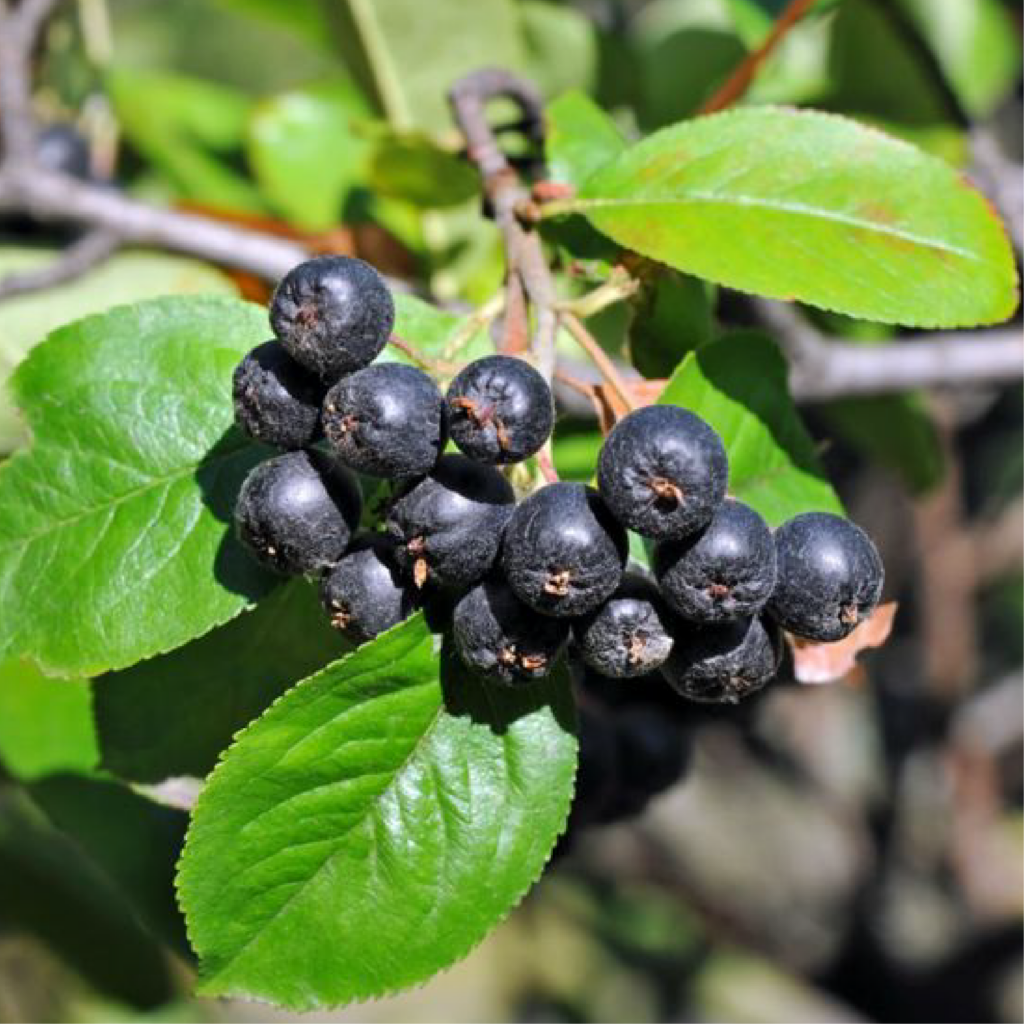
The berry is large for chokeberry, with an average diameter of around 8–10 mm and a weight of 1.0–1.5 g, uniform within the clusters, and regular in its round shape. The skin is firm, elastic, smooth, and glossy, and at full maturity it is intense black-violet to deep coal-black in color, covered with a fine light blue bloom. The flesh is dark purple, very firm, fleshy, and exceptionally juicy. The juice is intense dark red to inky in color and strongly stains skin and packaging during processing. The taste is refreshing, acidic-sweet, but with a recognizable, pronounced astringent note due to the naturally high tannin content.
It is characterized by extremely high genetic resistance to low winter temperatures. It is exceptionally naturally resistant to diseases and pests, so it can be grown successfully and profitably in the field without any use of chemical products, making it an absolutely ideal variety for fully organic, certified, and ecological production in commercial orchards and home gardens.
The root system is surface-level, shallow, and distinctly fibrous, which makes chokeberry highly sensitive to moisture deficiency during the summer months. It requires moderately moist, well-drained soils and regular irrigation, preferably a drip irrigation system, during June, July, and August, so that the berries do not remain small, shriveled, and bitter during the fruit-filling stage. It naturally forms many new roots, successfully binding and stabilizing soil on sloping and erosion-prone terrain.
Our chokeberry fruit plants are produced exclusively by vegetative propagation, by rooting green or mature cuttings under controlled conditions, and are supplied as own-rooted plants. This guarantees complete preservation of all varietal characteristics, premium vitality, and exceptional longevity of the shrub.