
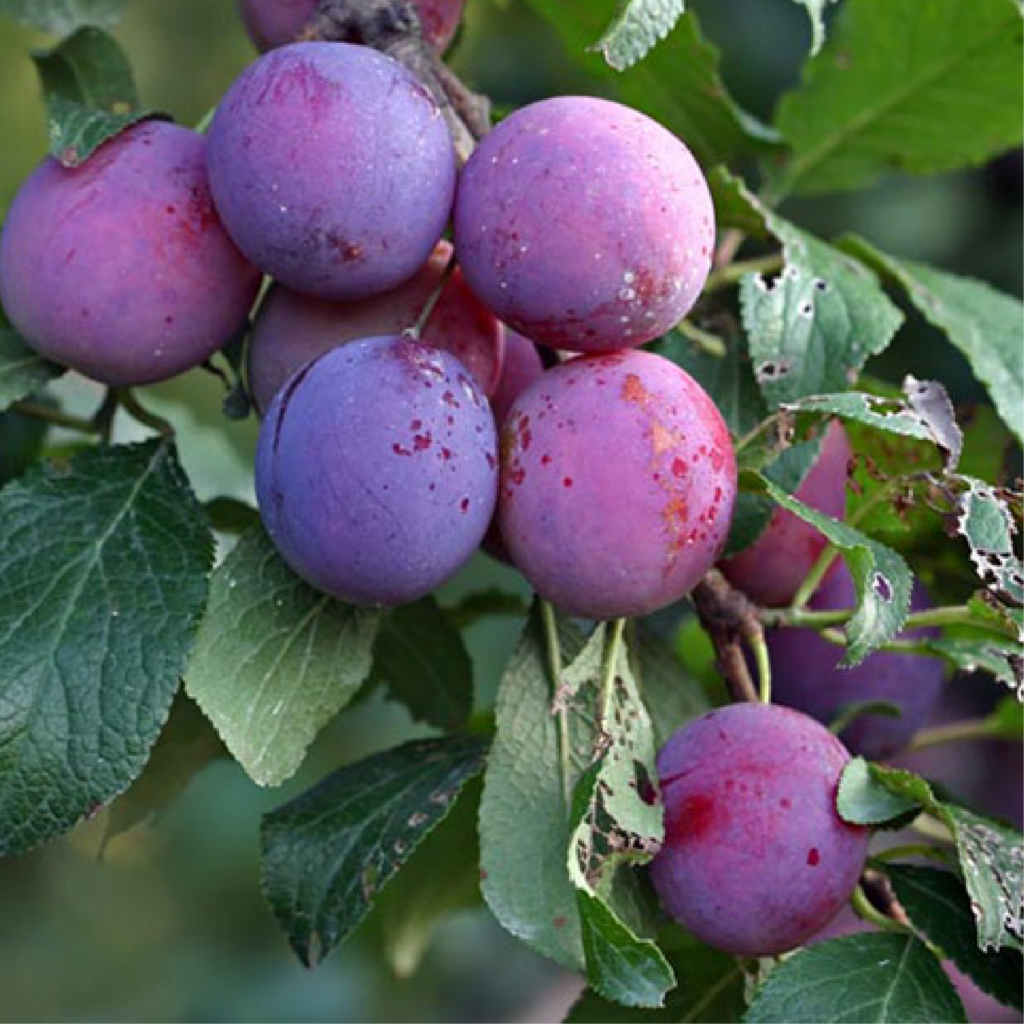
Stanley
Stanley originates from the USA, where it was developed in 1912. at the Experiment Station in Geneva, New York, and released into production in 1926. It was created through planned crossing of Prune d’Agen and Grand Duke, with the primary aim of obtaining a premium, large-fruited plum for drying. Due to its exceptional adaptability, early bearing, and high tolerance to Plum pox virus, it is today the most widely grown, most popular, and economically most important commercial plum variety in Serbia and throughout the region.
It is a fully self-fertile variety. It is characterized by outstanding, stable, and reliable fruit set with its own pollen, so it consistently produces maximum and record-breaking yields even when planted in large, pure single-variety blocks without other varieties. Due to its abundant flowering and extremely high-quality pollen, Stanley is a premium universal pollinator for almost all other autochthonous and bred plum varieties, such as Čačanska Rana and Čačanska Najbolja, that flower at the same time. It flowers medium-late, and flowering is long-lasting and abundant.
The tree is moderately vigorous to vigorous in youth, while in full bearing its growth becomes moderate. It forms a recognizable, open, airy, and broad-pyramidal canopy with strong scaffold branches that bend nicely under the weight of the crop. It enters the fruiting stage extremely early, often producing its first fruit as early as the second or third year after planting. Once it starts bearing, it produces regular, stable, and extremely abundant yields. Due to its tendency toward overcropping, it requires regular and strong pruning in order to thin the fruiting wood and maintain uniform fruit size.
It belongs to the group of late summer to early autumn plum varieties. In our region and under continental climatic conditions, it ripens in the second half of August, usually between August 20 and 30.
Harvesting, depending on the intended use, takes place from the end of August to mid-September. Fruit intended for fresh table consumption and drying is harvested somewhat earlier while still firm, while for processing into plum brandy, harvesting is delayed so that the fruit can accumulate the maximum sugar content.
In fresh condition, it can be successfully kept in cold storage for 2–3 weeks. Due to its exceptionally high dry matter content and favorable sugar-acid balance, it is the leading variety, both worldwide and domestically, for drying and producing prunes. In addition to drying, it is widely used as a universal raw material for the production of premium plum brandy, jams, thick plum preserves, compotes, as well as for mass fresh table consumption and export.
The fruit is large to very large, with an average weight of 35–40 g, and with good agricultural practice even over 45 g. It is uniform and characteristic in its elongated, oval-ovoid shape, with a pronounced belly and suture. The skin is firm and elastic, intense dark blue to purple at harvest, and completely covered with a dense, rich, and recognizable light blue bloom, or waxy coating. The flesh is initially greenish-yellow, later turning intense golden-yellow to amber at full maturity. It is very firm, compact, moderately juicy, fleshy, and distinctly sweet, with mild acidity and a pleasant aroma. The stone is relatively large and elongated. It belongs to the group of partially freestone plums: at full autumn maturity the stone separates easily, but in dry years or in incompletely ripe fruit, the flesh may partially adhere to the stone.
It is a highly tolerant variety to Plum pox virus, which is its greatest commercial advantage in the field. Even if the tree becomes infected, the virus does not cause premature fruit drop or fruit deformation, so it can be grown successfully and profitably in infected regions. On the other hand, it is highly susceptible to Monilinia blossom and fruit rot, Monilinia laxa, and plum rust, which in humid and rainy springs and autumns requires mandatory, regular, and timely preventive chemical protection at full bloom and immediately before harvest. It shows excellent resistance of the wood and buds to low winter frosts.
Our plum fruit trees are produced on the highly compatible, standard, and proven rootstock Myrobalan plum, Prunus cerasifera, with which this variety achieves a perfect graft union, excellent tree longevity, and outstanding adaptability to different soil types.