
Summerred
Summerred originates from Canada, where it was developed at the renowned Summerland Research Station in British Columbia as an open-pollinated seedling of McIntosh, and was released into wide production in 1964. Due to its attractive dark red appearance, early ripening, high productivity, and exceptionally refreshing acidic flesh taste, it is one of the most popular and sought-after varieties in the late summer apple class, ideal for the first market sales and home gardens.
It is a fully cross-pollinated, self-sterile variety. It cannot set fruit with its own pollen, so the presence of compatible pollinator varieties that flower at the same time is essential in the orchard. The best and field-proven pollinators for this variety are Gala, Idared, Golden Delicious, and Granny Smith. It flowers from medium-early to medium-late, abundantly, and over a long period.
The tree is moderately vigorous, with an attractive, wide, airy, and well-branched canopy, and branches that bend nicely under the weight of the crop. It enters the fruiting stage extremely early, often setting its first fruit as early as the second year after planting. Once it starts bearing, it produces abundant and high yields, but it has a very strong natural tendency toward alternate bearing and fruit set in dense clusters. For this reason, mandatory, early, and strong hand thinning of the fruit in early summer is required, leaving only one fruit per cluster, in order to prevent the crop from remaining small and the tree from entering a period of alternate bearing.
It belongs to the group of late summer to early autumn apple varieties. In our region and under continental climatic conditions, it ripens very early, at the end of July and in early August, usually between July 25 and August 10, around ten days before Mitchgla Gala.
Harvesting takes place at the end of July and during the first half of August. Since the fruit ripens fairly gradually on the tree, harvesting in the orchard is carried out selectively, in 2 passes, choosing only fully colored fruit. The fruit requires careful handling because its skin is sensitive to pressure.
Its storage ability is moderate and short, which is typical of all summer apple varieties. In standard cold storage, it successfully retains firmness and juiciness for only 2 to a maximum of 3 weeks. Due to faster loss of flesh quality, the fruit is less suitable for long storage and rough mechanical sizing, so it must be placed on the market immediately after harvest, before the flesh becomes dry and mealy. It is primarily a premium, refreshing table variety for early summer consumption, and it is excellent for home processing, first summer compotes, and juices.
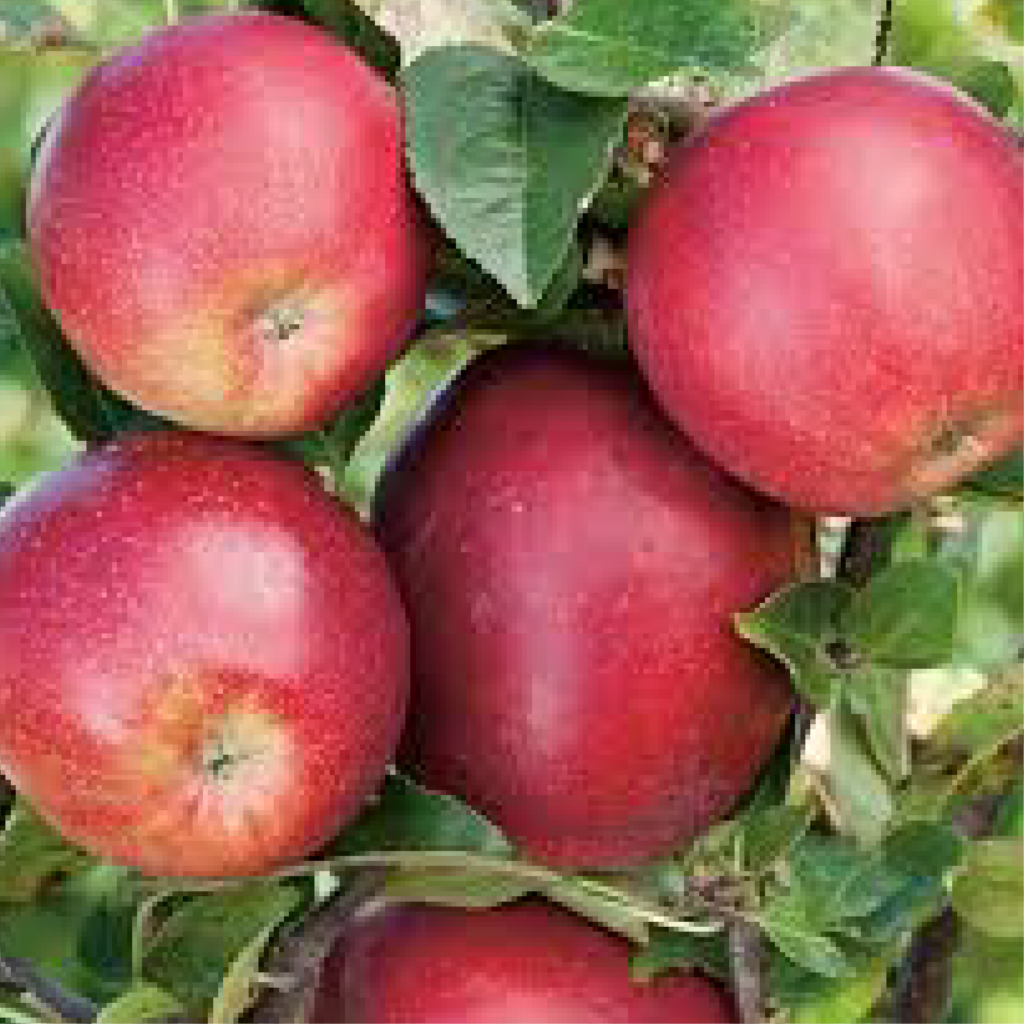
The fruit is medium-sized, with an average weight of 150–170 g, uniform, and regular oval-conical to slightly elongated in shape. The skin is thin, smooth, and glossy, with pronounced and clearly visible whitish lenticels, or small dots. The yellow-green ground color is covered over more than 70–85% of the fruit surface by a beautiful, attractive, intense bright red to dark red color on the sun-exposed side. The flesh is distinctly white, a characteristic inherited from McIntosh, moderately firm, compact, very juicy, and melting. The taste is outstanding and exceptionally refreshing, characterized by a fine, pronounced sweet-acidic balance and a luxurious, recognizable vinous aroma.
It is a moderately resistant variety. It shows outstanding resistance of the wood and flower buds to low winter temperatures and frosts, inherited from its Canadian origin. It is susceptible to apple scab on leaves and fruit, Venturia inaequalis, and to powdery mildew, which requires standard, regular preventive chemical protection throughout the growing season, with particular emphasis on protection from birds, which heavily attack the first summer fruit.
Our apple fruit trees are produced on highly compatible and certified rootstocks: M9, M9 T337, the Dutch standard for intensive high-density orchards with a support system, M26, which is excellent for this variety because it provides optimal growth strength on lighter soils, and MM106, an exceptional rootstock for this variety in home gardens and smaller orchards without a support system.