
Jonagold
Jonagold originates from the USA, where it was developed in 1943. at the Geneva Experiment Station in New York State by crossing Golden Delicious and Jonathan, and was released into wide commercial production in 1968. Due to its exceptional fruit size, perfect balance of sugars and acids, and outstanding productivity, it is considered one of the most popular and sought-after table apple varieties in Europe.
It is a distinctly triploid variety with sterile pollen. It cannot pollinate itself, nor can it pollinate any other variety in the orchard. For this reason, orchards with Jonagold must include two different diploid pollinator varieties that flower at the same time, such as Golden Delicious and Idared, or Granny Smith and Gala, in order to ensure cross-pollination of all varieties on the plot. It flowers from medium-early to medium-late.
The tree is highly vigorous, strong, and robust, with a wide, well-branched canopy and flexible branches richly covered with fruiting wood. It enters the fruiting stage very early, often as early as the second year after planting. Once it starts bearing, and with adequate cross-pollination, it produces regular, stable, and extremely high yields. It is prone to overcropping, which is why fruit thinning in early summer is essential in order to prevent fruit size reduction and the onset of alternate bearing.
It belongs to the group of autumn apple varieties. In our region and under continental growing conditions, it ripens at the end of September and in early October.
Harvesting takes place during the second half of September and in the first half of October. The fruit ripens gradually on the tree, so in intensive orchards harvesting is carried out selectively, in 2 to 3 passes, in order for all fruit to achieve ideal skin coloration.
Its cold storage ability is very good. In modern ULO cold storage with controlled atmosphere, it can be successfully kept for 5–7 months. The fruit tolerates picking, handling, and transport well when harvested at the proper technological maturity. It is primarily a premium table variety for fresh consumption, and due to its juiciness and rich flavor, it is highly valued in the industry for the production of premium natural juices.
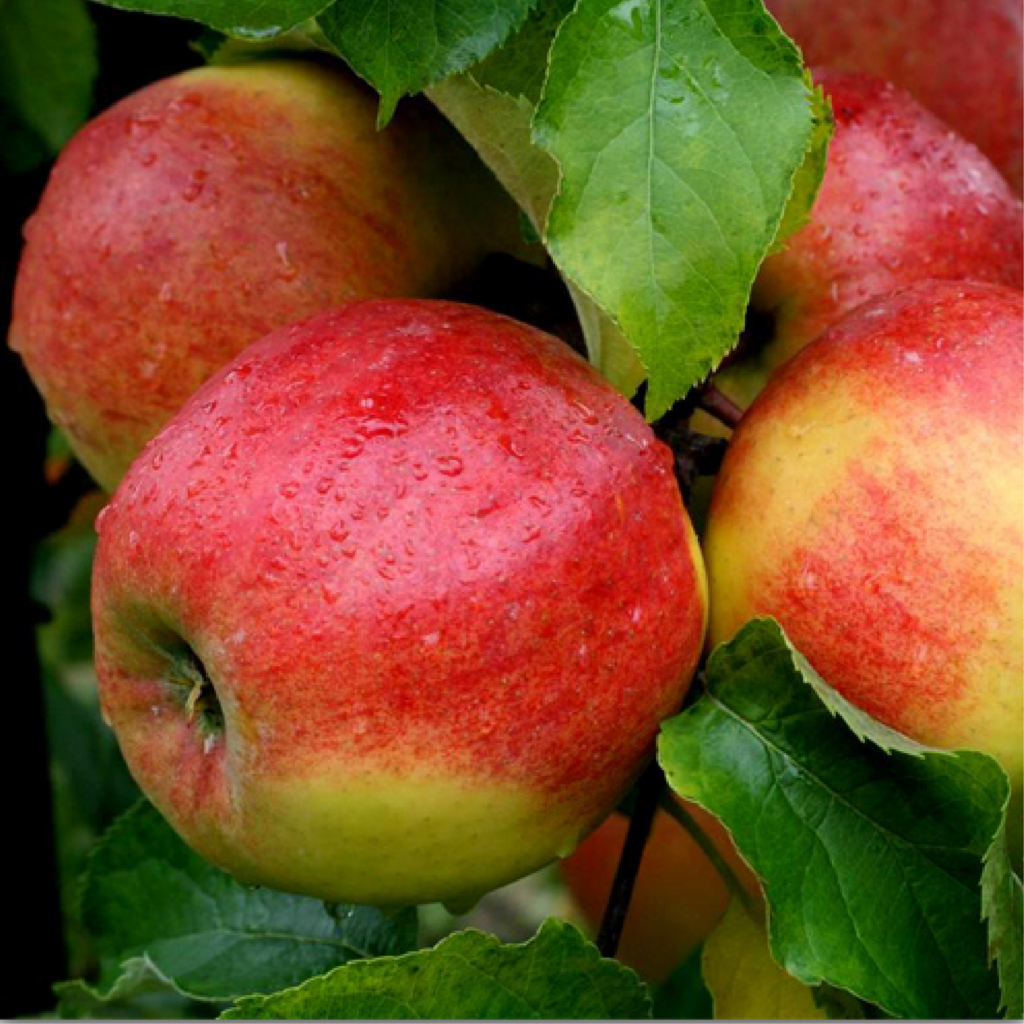
The fruit is large to very large, with an average weight of 180–250 g or more, uniform, and regularly roundish-conical in shape. The skin is thin and smooth, and at full maturity it is naturally prone to greasiness. The ground color is yellow-green, covered on the sunny side, over 40–60% of the surface, with an attractive orange-red blush and stripes. The flesh is light yellow, firm, compact, exceptionally juicy, and melting. The taste is outstanding, rich, full, and perfectly balanced between sweetness and moderate acidity, with a luxurious and recognizable aroma.
It is a moderately resistant variety. It shows good resistance of the wood to winter frosts, but the flower buds may be sensitive to late spring frosts. It is highly susceptible to apple scab on leaves and fruit, Venturia inaequalis, and to powdery mildew, so intensive and regular preventive chemical protection is required. During longer cold storage, it is prone to premature skin greasiness and the occurrence of bitter pit, which is why intensive calcium treatments are required during the growing season.
Our apple fruit trees are produced on highly compatible and certified rootstocks: M9, M9 T337, the essential standard for controlling the strong vigor of this variety in intensive orchards with a support system, M26, for medium-density orchards, and MM106, for more vigorous trees and home gardens, with which this variety achieves an excellent graft union.