
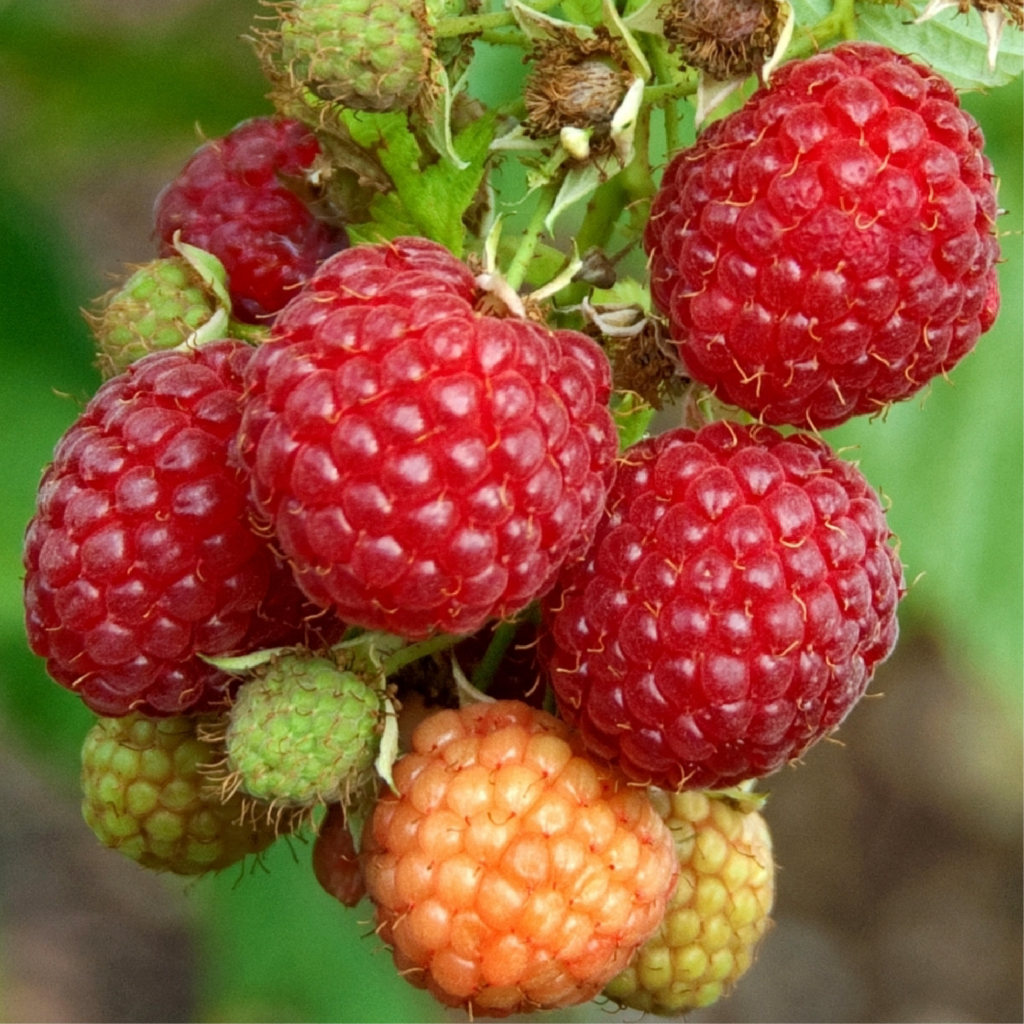
Willamette
Willamette originates from the USA, where it was developed in 1943. at Oregon State University, OSU, by the renowned breeder Dr. George Waldo, through planned crossing of Newburgh and Lloyd George. Due to its unsurpassed vitality, high productivity, exceptional frost resistance, and recognizable fruit firmness, it is the most widespread and economically most important raspberry variety in the world and in our region. It rightfully holds the status of a traditionally established variety that forms the solid foundation of Serbian production and the global export of “red gold.”
It is a fully self-fertile variety. It is characterized by an exceptionally high level of self-pollination and abundant flowering on two-year-old canes, so it reliably and stably produces maximum yields in pure single-variety plantations without any need for other pollinator varieties in the planting. It is an excellent universal pollinator for all other summer raspberry varieties. It flowers medium-early.
The plant forms very vigorous, strong, robust, and upright canes that, under good conditions, can reach a height of 2.5 to even 3 meters. The canes are fairly thorny, with slightly bent tips at the peak of full vegetative development. Due to its strong growth and abundant crop, it requires a mandatory, stable, and strong wire trellis support system, along with proper and timely cane thinning. It enters full bearing early, as early as the second year after planting, and produces regular, stable, extremely abundant, and record-breaking yields per hectare.
It belongs to the group of early summer-bearing, floricane-fruiting raspberry varieties. In our region and under continental climatic conditions, it ripens early, in mid- to late June, opening the main raspberry harvest season in our area.
Harvesting takes place during June and July and typically lasts around 3 to 4 weeks. The fruit separates very easily, smoothly, and cleanly from the receptacle once it reaches maturity, which greatly facilitates, speeds up, and reduces the cost of hand picking.
In fresh condition, it can be successfully kept in cold storage for 2–4 days. Due to its exceptionally compact flesh structure and firmness, it tolerates picking, handling, packing, and transport very well. It has an exceptionally high percentage of dry matter and acids, which makes it the number one variety worldwide and domestically for deep freezing, as it perfectly retains its full shape after thawing and provides the highest percentage of “rolend” quality. It is also widely processed into premium juices, jams, marmalades, fruit purées, and confectionery products.
The fruit is medium-sized to large, with an average weight of 3.2 to 4.2 g, exceptionally uniform throughout the entire harvest cycle, and attractive in its blunt-conical to rounded shape. The skin is firm, elastic, and glossy, initially bright red, while at full technological maturity it develops its recognizable, luxurious dark red to deep burgundy color. The flesh is compact, fleshy, firm, and very juicy. The taste is outstanding and refreshing, characterized by a fine, pleasant sweet-acid balance and a rich, intense, and recognizable aroma of true traditional raspberry.
It is characterized by extremely high genetic resistance to low winter frosts and low temperatures during dormancy, as well as excellent adaptability to different soil types on hilly and mountainous sites. It is moderately susceptible to root rot, Phytophthora, and gray mold of the fruit, Botrytis cinerea, in extremely humid and rainy years before harvest, which requires standard and regular preventive chemical protection.
The root system is surface-level, exceptionally strong, fibrous, and branched. It develops primarily in the upper soil layer and requires fertile, light, permeable, and well-drained soils, with mandatory provision of regular irrigation, preferably a drip irrigation system, during the summer months so that the fruit does not dry out and become underdeveloped due to drought. It naturally forms an exceptionally large number of root suckers, so it spreads, renews, and rejuvenates very quickly in the plantation every year.
We produce raspberry fruit seedlings exclusively vegetatively from strictly controlled and isolated nurseries. Certified / health-controlled planting material.