
Lapins
Lapins originates from Canada, where it was developed at the renowned Summerland Research Station in British Columbia through planned crossing of Van and Stella, and was named after the world-famous breeder Dr. Karl Lapins. It was released into production in 1983. Due to its complete self-fertility, exceptional fruit size, premium flesh firmness, and record-breaking yields per tree, it is one of the most popular, commercially most successful, and globally most sought-after late sweet cherry varieties in the world.
It is a fully self-fertile variety. Since it carries the genotype S₁S₄’, it is characterized by an exceptionally high level of self-pollination and extremely abundant fruit set with its own pollen, so it reliably and stably produces maximum yields in pure single-variety orchards without any need for other varieties in the planting. Due to its high germination capacity, abundant flowering, and exceptional pollen quality, Lapins is one of the best universal pollinators in the world for all other cross-pollinated sweet cherry varieties that flower at the same time. It flowers medium-late.
The tree is medium to highly vigorous, with recognizable, distinctly upright branch growth at sharp angles and a naturally weaker tendency toward lateral branching. If it is not pruned properly, the branches quickly develop bare areas inside the canopy. It enters full bearing extremely early, often producing its first commercial fruit as early as the second or third year after planting. It bears regularly, abundantly, and extremely stably every year. Due to its pronounced tendency toward overcropping in clusters, mandatory strong winter and summer, or green, pruning is required in order to stimulate lateral branching and thin the fruiting elements so that the fruit does not become undersized.
It belongs to the group of late sweet cherry varieties. In our region and under continental climatic conditions, it reaches harvest maturity in the second half of June, usually between June 15 and 25, in the fifth and sixth weeks of the sweet cherry season, ripening several days after Stella.
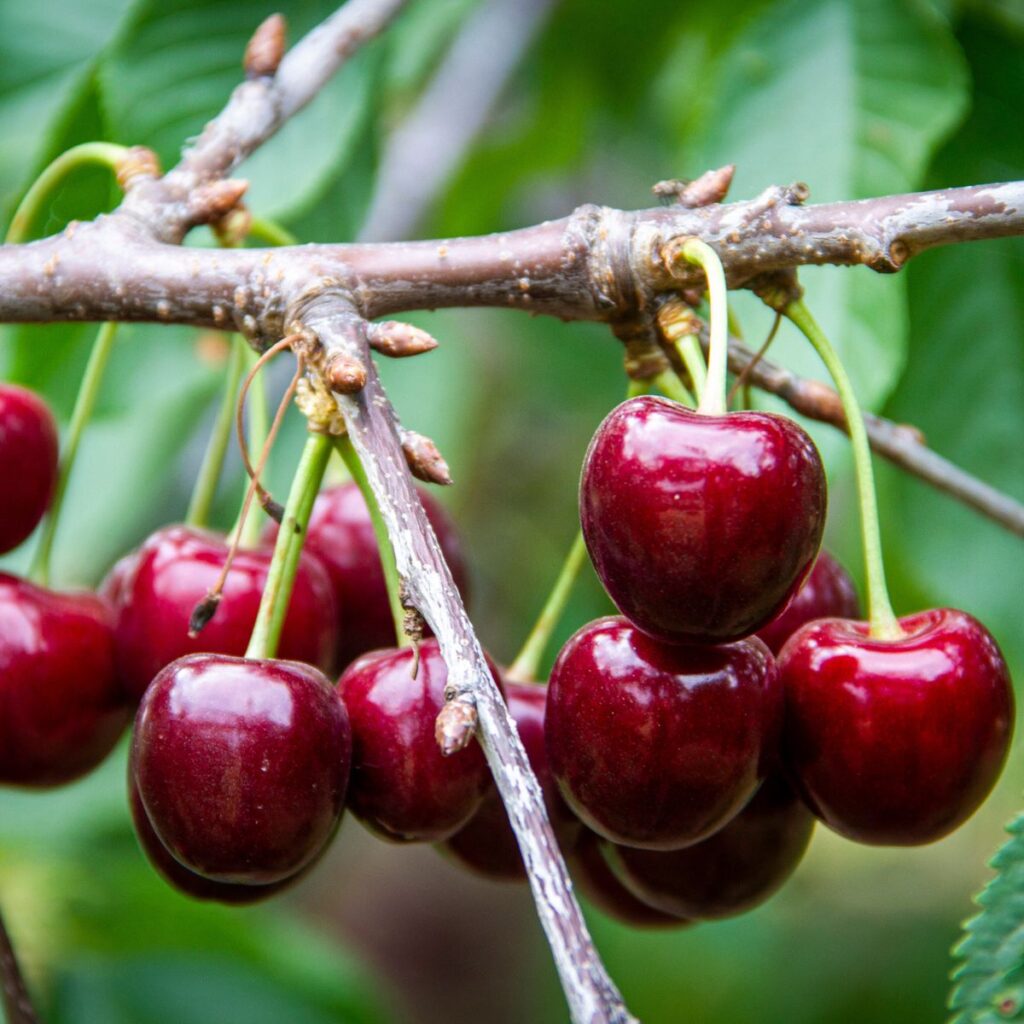
Harvesting takes place during the second half of June. The fruit ripens fairly uniformly on the tree and is characterized by a recognizable, short, and thick green stem, which makes it hold extremely firmly on the branches, prevents it from dropping on its own due to wind, and facilitates fast picking.
It is characterized by premium long-term storage ability. In fresh condition, it can be successfully kept in cold storage for 2 to even 3 weeks while retaining full freshness. Due to its extremely firm and fleshy fruit and elastic skin, it tolerates picking, rough mechanical sizing, packing, and long-distance transport perfectly, without any risk of crushing or juice leakage. It is a leading premium favorite for global commercial export. It is used exclusively for luxury fresh table consumption.
The fruit is exceptionally large to giant, with an average weight of 9 to over 11 g and a caliber diameter exceeding 28–30 mm. It is uniform on the tree and regular in shape, attractive and roundish-heart-shaped. The skin is firm, elastic, smooth, and distinctly glossy, bright red at harvest, turning beautiful dark burgundy to glossy coal-black at full technological maturity. The flesh is dark red, very firm, compact, and recognizably crisp, typical of a distinctly firm-fleshed sweet cherry, and exceptionally juicy. The taste is outstanding, rich, and full, characterized by high sugar content perfectly balanced with fine, pleasant acidity, along with a luxurious and recognizable varietal aroma. The stone is small to medium-sized and separates easily from the flesh.
It is moderately resistant to diseases. It shows excellent natural resistance of the wood and flower buds to low winter frosts during dormancy. One of the greatest pomological advantages of this variety is the exceptionally high natural resistance of the fruit to cracking caused by heavy summer rains during the ripening period, making it highly reliable and profitable for field cultivation. In humid and rainy June conditions, it requires standard preventive chemical protection against Monilinia fruit rot, Monilinia laxa, and other fruit rots, as well as mandatory protection from birds, which are attracted by the large, dark crop.
The root system is strong, deep, and branched. It uses moisture and nutrients from deeper layers very well, but it absolutely does not tolerate heavy, compacted, clayey, or waterlogged soils, where excess groundwater quickly causes root asphyxia, or suffocation, and tree decline. It requires deep, permeable, light, and fertile soils on sunny and well-ventilated sites.
Our sweet cherry fruit trees are produced on highly compatible, certified rootstocks: mahaleb cherry, Prunus mahaleb, and wild sweet cherry for classic and long-lived orchards. In addition to vigorous rootstocks, we also produce fruit trees on modern low- to medium-vigor vegetative rootstocks Gisela 5 and Gisela 6, which are the globally mandatory standard for this variety, as they ideally control its natural vigor and upright growth, prevent the formation of overly tall and inaccessible branches, drastically accelerate entry into full bearing, as early as the second year, and enable the establishment of intensive, super-high-density orchards.