
Kelleris 16
Kelleris 16 originates from Denmark, where it was developed at the renowned Kelleris breeding station by breeder H. Nikand, through planned crossing of Morello and Early Richmond. Due to its exceptional and stable productivity, excellent compatibility with rootstocks, and high mechanical resistance of the fruit, it is one of the most widespread and important commercial sour cherry varieties for intensive orchards and industrial processing throughout Europe.
It is a fully self-fertile variety. It is characterized by an exceptionally high level of self-pollination and abundant flowering every year, so it reliably and independently of weather conditions produces phenomenal yields in pure single-variety orchards. It flowers medium-early.
The tree is naturally low to moderate, or medium, in vigor, with a recognizable upright, moderately dense, and pyramidal canopy whose branches spread and open nicely only under the weight of an abundant crop. It enters full bearing extremely early, often producing its first commercial fruit as early as the second year after planting. It bears regularly, abundantly, and extremely stably every year. Due to its tendency toward overcropping, it requires regular and proper pruning in order to continuously renew fruiting wood and improve light penetration inside the canopy.
It belongs to the group of medium-late sour cherry varieties. In our region and under continental climatic conditions, it ripens in the second half of June, usually between June 22 and July 2, only a few days after the domestic Oblačinska sour cherry.
Harvesting takes place at the end of June and in early July. The fruit ripens fairly uniformly on the tree and is characterized by an exceptionally firm attachment to the stem, which prevents it from dropping on its own in stronger winds. This botanical trait makes it perfectly adapted to mechanized harvesting with specialized shakers and harvesters on large commercial plots.
It has poor fresh-storage ability after harvest, around 5–7 days, which is standard for industrial fruit. Due to its high acid content, specific sharp aroma, and exceptionally firm flesh, it is a premium industrial variety. It is widely used as first-class raw material for deep freezing, including pitted frozen fruit, for the production of clear and cloudy juices, syrups, premium jams, compotes, as well as for distilling aromatic sour cherry brandy and producing liqueurs.
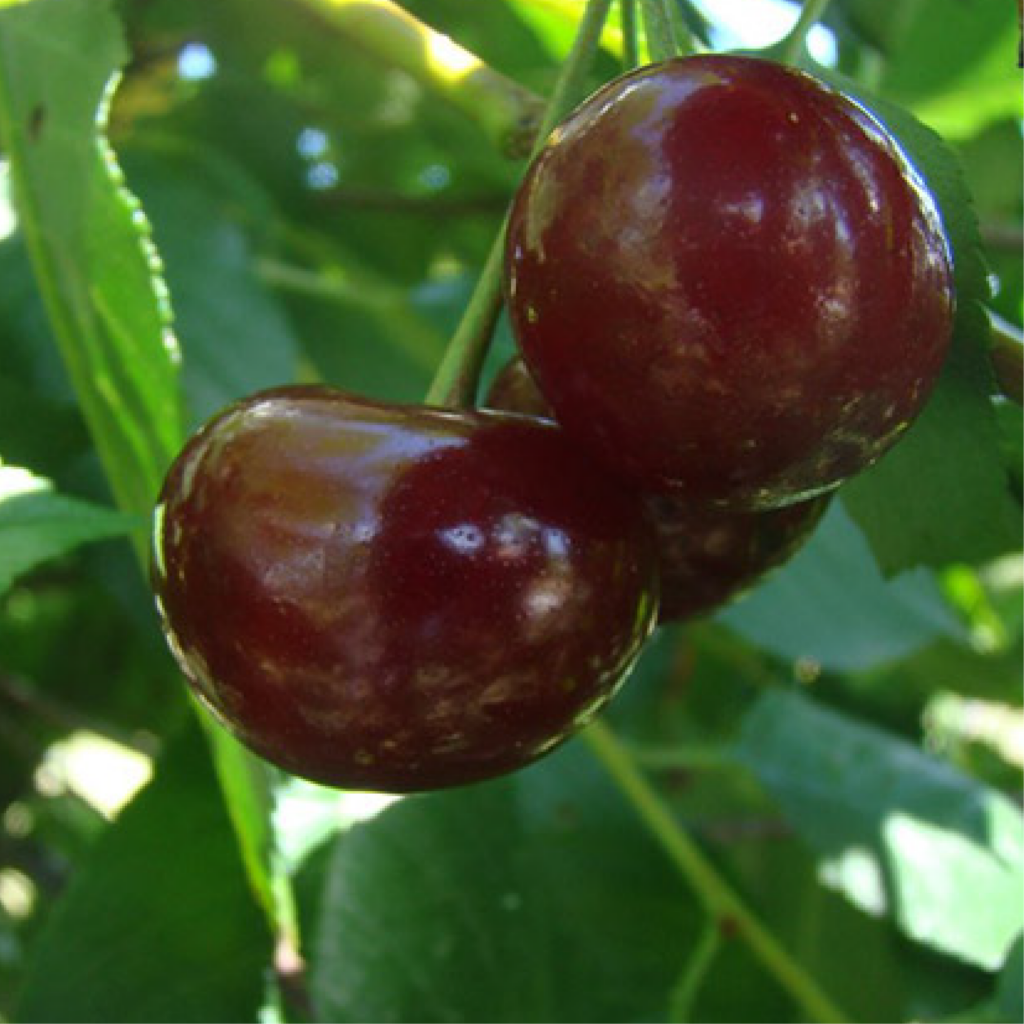
The fruit is medium-sized to large for a sour cherry, with an average weight of 4–4.5 g, noticeably larger than Oblačinska sour cherry. It is uniform on the tree and regular in shape, oval to slightly elongated, with a rounded tip. The skin is thin, smooth, and glossy, with an attractive dark red to deep burgundy color at full maturity. The flesh is light red, exceptionally firm, compact, and tough, or crisp, in consistency, and very fleshy. The juice is light pink to almost colorless, or clear, which is characteristic of varieties from the amarelle group and a major advantage because it does not stain skin or fabrics during processing. The taste is distinctly acidic, refreshing, and very aromatic. The stone is medium-sized and elliptical, and the variety belongs to the group of true freestone sour cherries: it separates from the flesh completely easily, smoothly, and cleanly, which facilitates mechanical pitting.
It is characterized by outstanding natural resistance of the wood and flower buds to extremely low winter frosts and low temperatures during dormancy. It is moderately susceptible to cherry leaf spot, Blumeriella jaapii, so it requires standard fungicide protection after harvest in order to retain its leaves until late autumn. On the other hand, it is highly susceptible to Monilinia blossom and twig blight, Monilinia laxa, which in humid and rainy springs requires mandatory, maximally strict, and regular preventive chemical protection during full bloom and petal fall.
Our sour cherry fruit trees are produced on the highly compatible, standard rootstock mahaleb cherry, Prunus mahaleb, with which this Danish variety achieves perfect natural compatibility, exceptional tree longevity, and outstanding resistance to dry summer periods and calcareous soils.